James Hardie New Detached ADU: The Orange County Owner’s Guide
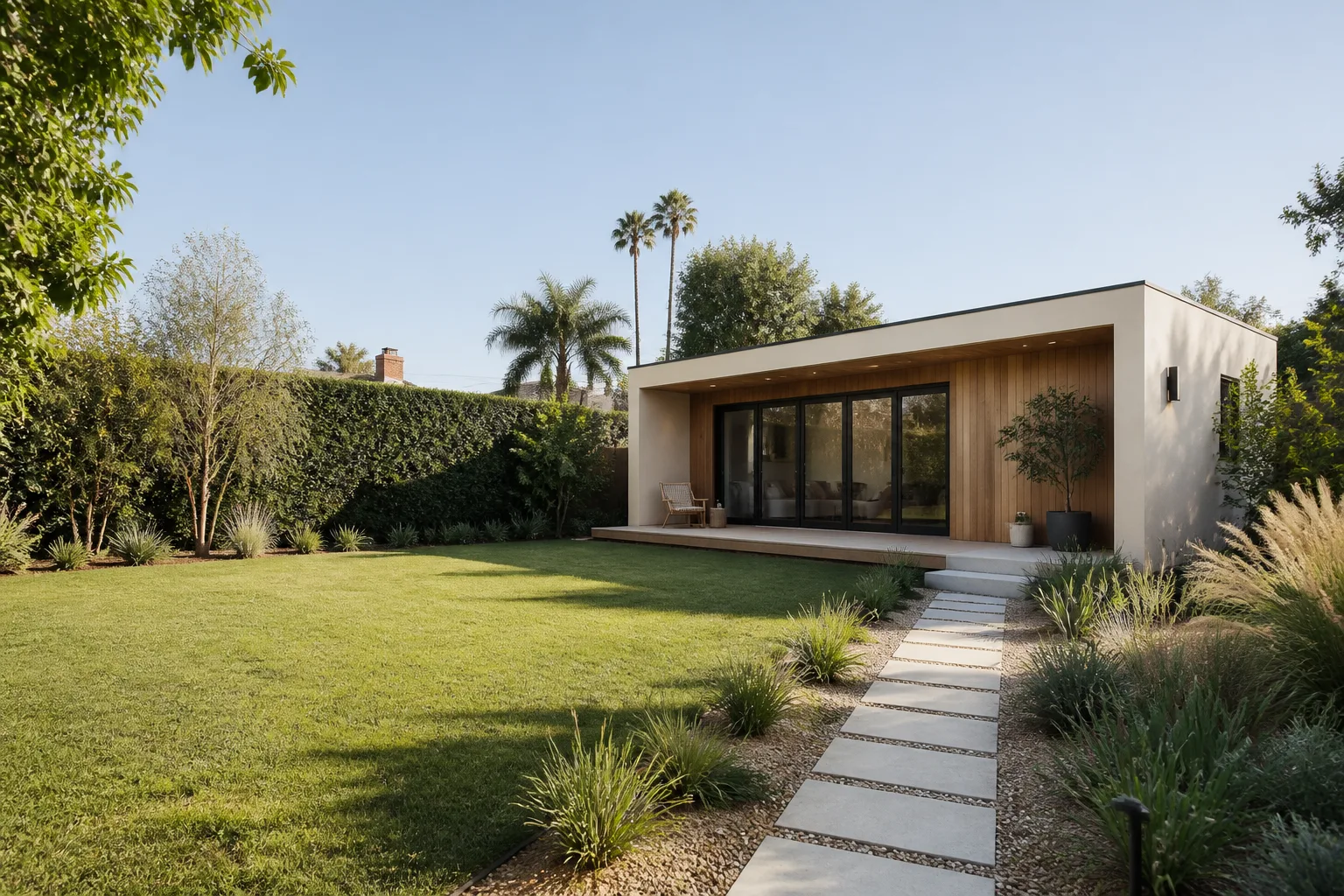
A James Hardie new detached ADU in Orange County typically costs $180,000 to $320,000 fully permitted and built, depending on slab conditions, utility runs, and the siding package you choose. We keep James Hardie fiber cement siding, trim, and soffit in stock, and we’re one of the few crews in Orange County installing it on detached ADUs week in and week out. Most owners call us after a failed siding install or a water leak behind Hardie plank: the boards are warping, the caulk lines have split, or a corner trim piece has pulled away and you can see daylight where you shouldn’t. They’re usually standing at the side of the structure with a phone light, hoping it’s a quick fix.
Which James Hardie Models This Applies To
We work with the full James Hardie fiber cement line for detached ADUs: HardiePlank lap siding (5.25″ and 8.25″ exposures), HardiePanel vertical siding, HardieTrim boards (4/4 and 5/4), and HardieSoffit. The biggest compatibility gotcha in Orange County is thickness: most prefab ADU kits and older garage conversions were built for 5/16″ lap siding. If a previous contractor installed HardiePlank at 5/16″ on framing spaced wider than 16″ on center, the boards flex, the caulk cracks, and water gets behind the siding in the first rainy season. James Hardie’s spec is clear: 5/16″ is rated for 16″ on-center framing, and 7/16″ for 24″ on-center. We check framing spacing on every estimate because half the failed installs we see in Anaheim Hills and North Tustin are 5/16″ boards on 24″ framing. For OEM versus aftermarket: HardieTrim and HardiePlank should be genuine James Hardie, because the color-matched caulk and touch-up system is proprietary. Nails, flashing, and weather barrier can be quality aftermarket (we use stainless nails and Vycor flashing), but we stock genuine James Hardie on the truck.
Signs Your James Hardie New Detached ADU Is Failing
- Caulk lines splitting or pulling away at the butt joints. HardiePlank moves with temperature swings, and in Orange County’s hot afternoons and cool nights the boards expand and contract enough to break cheap painter’s caulk. That gap draws water behind the siding every time it sprinkles. Hardie’s spec calls for sealant that handles at least 25% joint movement.
- Boards feeling soft, swollen, or crumbling at the bottom edge. The bottom course should sit at least 6″ above finished grade. If sprinklers, mulch, or soil are touching the plank, fiber cement wicks water and the board degrades from the bottom up. We see this on older garage conversions in Fullerton and Garden Grove where flower beds got added after the fact.
- Cut edges that are unpainted or unprimed showing through at corners and windows. Factory-finished edges are primed, but every field cut exposes raw fiber cement, which soaks water. An installer who didn’t prime field cuts or use Hardie’s blush-free joint treatment left the structure open to flaking and board blow-out.
- Nailing pattern visible as small bulges or puckers running down a stud line. HardiePlank needs nails every 16 inches, driven flush or just above the board surface, never countersunk. If a handyman buried nail heads with a framing nailer, you’ll see blush and rust spots within a season or two, and eventually the board pops.
- Trim pieces with gaps at inside corners or window heads. HardieTrim is a rigid board, and if it wasn’t back-flashed and sealed at every joint, water tracks behind the trim and rots the rough opening framing underneath. The siding looks fine from ten feet away, but poke the corner and the trim moves.
Replacement Cost & What’s Included
For a standard 400 – 600 square foot detached ADU in Orange County, replacing James Hardie siding and trim runs $14,000 to $28,000 installed. That includes removing and disposing of the failed boards, inspecting and replacing the weather barrier where needed, re-flashing windows and corners, priming every field cut, color-matching to your existing Hardie palette, and caulking every joint with movement-rated sealant. A partial repair, like replacing one bad course or one corner trim run, typically runs $900 to $2,200 depending on access and how much flashing gets replaced. Every project gets the written price before we start, and every replacement is backed by our 365-Day Done Right Promise: if the work fails within the year, we come back and make it right at no charge. That’s in writing, on your copy before the first board comes off the wall.
| Scope | Typical Orange County Range |
|---|---|
| Full ADU siding replacement (HardiePlank lap, 400 – 600 sq ft) | $14,000 – $28,000 |
| Partial siding repair (one wall or one section) | $3,500 – $7,000 |
| Trim and corner replacement with flashing | $1,500 – $4,000 |
| Soffit replacement, vented HardieSoffit | $2,800 – $5,500 |
| Inspection and written report | Free with a repair estimate |
DIY or Call Us?
Fiber cement siding replacement is not spring-tension dangerous, but it is shoulder-heavy, ladder-heavy, and detail-heavy work, and the failure mode is hidden water damage you won’t see until it’s expensive. You can safely do a visual check: walk the perimeter and look for the signs above, especially caulk cracks and gaps behind trim. What we’d steer you away from: cutting fiber cement with a circular saw and no dust control: the silica dust is a lung hazard, not a weekend project. And if you’re pulling boards off, you need to fix the flashing and water barrier while the wall is open, or the new Hardie fails exactly like the old one did. If you’d rather have the wall checked by someone who has been installing James Hardie across Orange County for years, call us at (350) 203-6060 and we’ll take a look and hand you a written price.
FAQs
Properly installed James Hardie siding lasts 30 to 50 years in Orange County’s dry, mild climate, and the factory finish is warrantied for 15 years. Installations that fail early almost always fail at the details: wrong board thickness for framing spacing, unprimed cuts, bad caulk, or bad flashing. It’s rarely the board that fails; it’s the water getting behind it. Call (350) 203-6060 for an exact quote on your ADU, estimates are free.
Yes, if the damage is localized. A split board, pulled trim piece, or a failed caulk run can usually be repaired in a few hours without touching the rest of the wall. But if water has been getting behind the siding for more than a season, the sheathing and framing under it need to be inspected before we put anything back. Call (350) 203-6060 and we’ll tell you honestly if it’s a repair or a replacement.
A full siding replacement on a detached ADU typically takes 5 to 8 working days in Orange County; partial repairs are usually done in a day. We give you a defined arrival window before we start and we leave the job site cleaner than we found it, every time. Call (350) 203-6060 to schedule a free estimate.
We stock HardiePlank lap siding, HardiePanel, HardieTrim, and HardieSoffit in our Orange County trucks, along with color-matched caulk and touch-up kits. If your ADU was built with a less common color from the Hardie palette, we can source it same-week from our local supplier. We also work with detached ADUs from Abodu, Cover, and Dvele, so we carry the matching trim and flashing for those brands too.
This is what we do: we walk the structure, figure out where the water is getting in, hand you a written price, and then do the job the Kingswell way: the price doesn’t change at the door, the crew shows up in the window we gave you, and the work is guaranteed in writing. Tell me what you need the space to do, and we’ll figure out the honest way to get there. Call (350) 203-6060 for your free estimate.
Written by Russ Delmar, Owner, Lodgewick ADU Orange County at Lodgewick ADU Orange County, serving Orange County and nearby areas.