Last updated October 15, 2026
DIY vs Professional ADU: The Orange County Homeowner’s Decision Guide
You can legally swing a hammer on your own ADU in California. But the moment you pull a permit as owner-builder, your construction lender may walk, your homeowner’s policy may not cover the structure, and you become personally liable for every subcontractor injury on site. That’s the part nobody tells you at the big-box store. This guide walks through what California’s owner-builder permit actually allows, what it requires you to attest to, the insurance gap most Orange County homeowners don’t know exists, and a practical decision matrix for which parts of an ADU you can safely self-perform and which you should hand to a licensed contractor. For how to hire an ADU contractor in Orange County: a step-by-step guide, see our dedicated resource.
Quick Answer
Most Orange County homeowners should hire a licensed contractor for the structural, electrical, plumbing, and permit-intensive portions of an ADU, while self-performing only finish work like painting, demo of non-structural elements, and finish landscaping. The deciding factors aren’t skill level; they’re permit liability, construction loan eligibility, and homeowner’s insurance coverage. A garage conversion or detached new-build ADU is professional territory, while an interior JADU offers limited safe DIY scope.
Table of Contents
- What California’s Owner-Builder Permit Actually Allows
- The Insurance Gap Most Homeowners Don’t Know Exists
- Why Construction Lenders and HELOCs Require a Licensed Contractor
- What You Can Safely Self-Perform Without Voiding Permits or Warranties
- The Real Cost Comparison: DIY vs Professional
- Decision Matrix by Project Type
- The 7-Year Resale Disclosure You’re Signing Up For
- Common Mistakes to Avoid
- When to Call a Professional
- Frequently Asked Questions
- The Bottom Line
What California’s Owner-Builder Permit Actually Allows
California law says an owner can pull a permit and act as their own general contractor on residential property they own and occupy. That’s true. What the law does not say is that this is a good idea for a project the size of an ADU in Orange County. Here’s what you’re actually signing when you file as owner-builder with a city like Anaheim, Santa Ana, Irvine, or Huntington Beach.
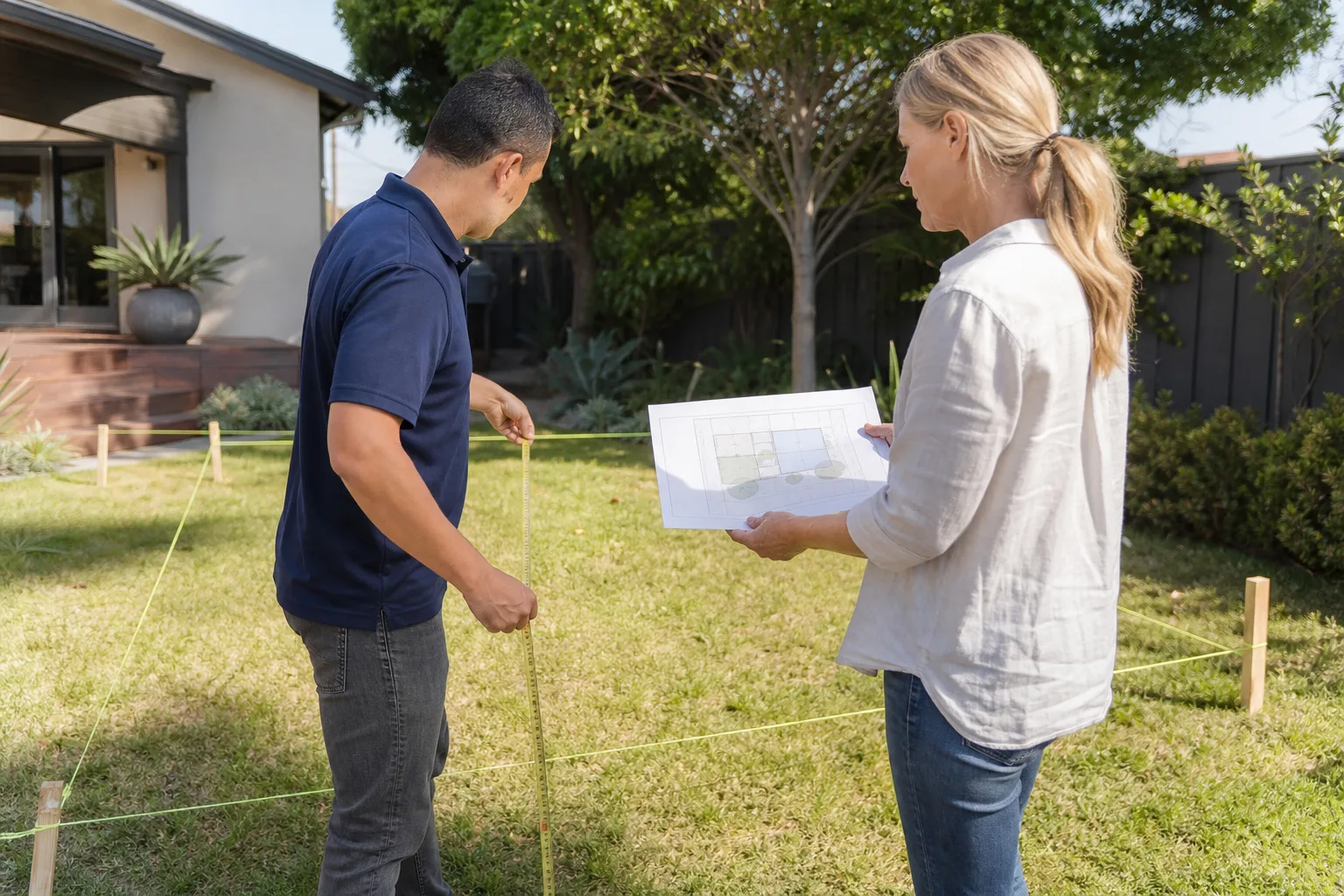
First, you sign a legal attestation declaring you are personally performing the work or directly hiring and supervising all subcontractors. That attestation isn’t boilerplate. It makes you responsible for worker’s compensation coverage for anyone you hire who doesn’t carry their own policy. If a laborer you found on a referral site gets hurt on your property and they don’t have their own workers’ comp, that’s a claim against you. Most Orange County homeowners don’t carry a workers’ comp policy because, well, they’ve never been an employer. As an owner-builder, you become one.
Second, you become personally responsible for code compliance. When a licensed contractor pulls a permit, the contractor’s license is on the line with the Contractors State License Board. When you pull an owner-builder permit, your home equity is on the line. The city inspector doesn’t care who built it. They care that it meets current code. If it doesn’t, you fix it. If you can’t fix it, you pay someone to fix it. That’s not a risk transfer; that’s a risk you keep.
Third, owner-builder permits trigger mandatory resale disclosure obligations in California. More on that in the disclosure section below, but understand the broad strokes now: anything built under an owner-builder permit must be disclosed to any future buyer for seven years after completion. That’s not a suggestion. It’s in the California Civil Code.
- You file the permit application as owner-builder with your city’s building department.
- You sign the owner-builder attestation declaring you will personally perform or directly supervise all work.
- You assume responsibility for worker’s compensation, code compliance, and subcontractor management.
- You accept the resale disclosure obligation that follows the property for seven years.
In our experience building ADUs in Orange County, we’ve walked onto owner-builder sites where the homeowner had no idea they’d signed away their protection. The permit process isn’t the hard part. Accepting the liability is.
The Insurance Gap Most Homeowners Don’t Know Exists
A standard homeowner’s policy covers your primary residence. An ADU under construction is a different animal. When you hire a licensed contractor, that contractor carries general liability insurance, which covers property damage and injuries caused during construction. When you act as owner-builder, nobody covers that gap unless you buy a separate course-of-construction policy.
Here’s the scenario we’ve seen play out more often than you’d think. A homeowner in Mission Viejo starts a detached ADU as owner-builder. A subcontractor’s truck rolls into the neighbor’s fence, doing $8,000 in damage. The homeowner’s policy doesn’t cover construction activity. The subcontractor didn’t have their own policy. The homeowner is writing a check to the neighbor, and the relationship with that neighbor is never quite the same.
Even after construction is complete, there’s a coverage question. Many insurers ask during underwriting whether any unpermitted work exists on the property, and some specifically ask about owner-builder construction. If the work was done correctly, this isn’t a problem. But if a future claim traces back to a defect in the ADU’s electrical or plumbing, the insurer may ask who built it and whether it was permitted. If the answer is “an owner-builder with no contractor’s license,” the claim can get complicated fast. Some insurers will pay and then non-renew. Others will deny. It depends on the carrier and the specific policy language, but the risk sits with you.
This is one of the strongest arguments for hiring a licensed home addition contractor in Orange County for the structural and systems work. The contractor’s insurance exists precisely because construction risks are real and incidents happen even on well-run jobs. As a homeowner, you already pay for insurance to protect your home. You shouldn’t be surprised to learn that your existing policy wasn’t designed to cover a construction project.
Why Construction Lenders and HELOCs Require a Licensed Contractor
If you plan to finance your ADU, the owner-builder question may already be answered for you. Most construction lenders, including the ones writing ADU-specific loans in Orange County, require a licensed general contractor to be named on the loan documents. The reason is simple: lenders underwrite against the certainty that the project will be completed to code and at a predictable cost. A licensed contractor provides a fixed-price contract, a license number the lender can verify, and a track record of completed projects. An owner-builder provides none of those things from a lender’s perspective.
HELOCs are trickier. Many homeowners assume they can draw on a HELOC to fund a DIY ADU because the money is already in their name. But HELOC agreements often restrict use of funds for construction unless the work is being done by a licensed contractor. This isn’t enforced when you buy furniture or pay for a child’s wedding. It can absolutely be enforced if the bank discovers the funds went to an owner-builder construction project that later results in a claim or a code violation.
Even if no financing is involved, the appraisal question matters. An ADU adds value only when it’s permitted, built to code, and documented as a legal dwelling unit. Unpermitted or owner-builder work with code issues gets flagged during appraisal. In Orange County’s competitive real estate market, an appraiser comparing your property to nearby comps will note whether the ADU is legally permitted. If it isn’t, the value may not be what you expect.
The takeaway: if you’re financing the ADU, you’re almost certainly hiring a licensed contractor. The financing tail wags the DIY dog.
What You Can Safely Self-Perform Without Voiding Permits or Warranties
We’re not here to tell you to stay off the job site entirely. There’s a meaningful amount of work you can do yourself that won’t void permits, invalidate warranties, or create liability. The key is knowing where the line is.
Safe DIY tasks during an ADU build:
- Demo of non-structural elements: If you’re converting a garage, you can pull drywall, remove old shelving, and clear out the space before the contractor starts. Save the framing, electrical, and plumbing demo for the pros.
- Painting: Interior and exterior painting is low-risk, doesn’t require a permit, and can save you a meaningful amount. Orange County’s climate means you can paint most of the year, unlike colder markets where temperature windows are tight.
- Finish landscaping: After the ADU is complete, the yard is yours. Planters, pavers, irrigation, and turf installation around a new ADU don’t require permits in most Orange County jurisdictions if the construction is complete.
- Finish carpentry: Baseboards, door casings, and simple trim work are low-liability tasks. If you can measure twice and cut once, you can handle these.
- Hardware and fixtures: Cabinet hardware, towel bars, and light fixtures (if you’re comfortable with basic electrical after the circuit is in place) are reasonable DIY scope.
What you should NOT self-perform:
- Electrical: Panel work, new circuits, and service upgrades require a licensed electrician and a permit. This is not about skill. It’s about code compliance and fire safety.
- Plumbing: New supply lines, drain lines, and especially anything touching the sewer connection belongs to a licensed plumber. A failed sewer connection under an ADU slab is a five-figure fix.
- Foundation work: A detached ADU sits on concrete. That work is structural, permanent, and unforgiving. No amateur should pour a foundation.
- Roofing: Even on a small ADU, roofing mistakes leak into everything below. Hire a roofer.
- HVAC: Mini-split installation involves refrigerant lines. Federal law requires EPA certification to handle refrigerant. You’re not allowed to do it yourself, period.
For homeowners in Orange County planning a garage conversion, the DIY scope actually shrinks compared to a detached build. Garage conversions typically require adding a bathroom and kitchenette, which means plumbing and electrical rough-in. Once those trades are in, the finish work opens back up for you.
The Real Cost Comparison: DIY vs Professional
Here’s an honest look at what a professional contractor actually adds to your project in overhead and profit, and what DIY mistakes actually cost first-time owner-builders. These numbers reflect the Orange County ADU market, where labor is expensive and permitting takes time.
What a contractor’s 20 – 30% overhead and profit actually buys you:
- Subcontractor relationships: A good contractor has electricians, plumbers, and framers who show up because they have ongoing work with that contractor. Owner-builders call the same subs and get the “I’ll fit you in” answer.
- Code knowledge: Orange County city codes vary. What passes in Santa Ana may not pass in Newport Beach. A contractor who builds in your city knows the local inspectors and their preferences.
- Schedule management: A general contractor coordinates trades so the plumber isn’t there before the framing is done. Owner-builders learn scheduling the hard way, which means rebookings and delays.
- Pricing certainty: A written contract with a fixed price means the number doesn’t change because a sub bid came in high. Owner-builders get the high bid pass-through directly.
- Warranty enforcement: When a licensed contractor’s work fails, you have a contract and a license bond to pursue. When a sub’s work fails on an owner-builder job, you have a phone number and a hope.
What DIY mistakes actually cost, based on what we’ve seen in Orange County:
| Mistake | Typical Cost to Fix | How Often We See It |
|---|---|---|
| Improperly framed wall that fails inspection | $1,500 – $4,000 | Common |
| Electrical work that fails inspection | $800 – $2,500 | Common |
| Plumbing leak discovered after drywall is up | $3,000 – $8,000 | Occasional |
| Foundation pour that needs correction | $10,000 – $25,000 | Rare but catastrophic |
| Subcontractor worker injury with no workers’ comp | $15,000 – $100,000+ | Rare but catastrophic |
| Permit reapplication after plan rejection | $1,000 – $3,000 per cycle | Common |
When you add up the mistakes, the delays, and the sub coordination time you’re spending, the contractor’s 20 – 30% starts to look like an insurance policy rather than a markup. That’s what we tell homeowners when they ask us for an honest comparison.
Decision Matrix by Project Type
Here’s our honest take on which ADU project types in Orange County can tolerate some DIY work, and which ones can’t. This isn’t about protecting our business. It’s about giving you the straight answer we’d give a neighbor.
- Garage conversion: Professional strongly recommended. A garage conversion involves structural changes to an existing building, new plumbing for a bathroom or kitchenette, new electrical circuits, and insulation and drywall throughout. The permitting process in most Orange County cities requires engineered drawings and multiple trade inspections. DIY scope: demo, painting, finish landscaping. Everything else belongs to a licensed contractor.
- Interior JADU (junior accessory dwelling unit): Some DIY possible. A JADU is built within the existing walls of your home, typically converting a bedroom or bonus room into a small living unit with a kitchenette. Because it’s within existing conditioned space, the structural work is minimal. If the room already has plumbing nearby, the scope is even smaller. DIY scope: demo, painting, finish carpentry, flooring. Professional scope: electrical, plumbing, any wall changes.
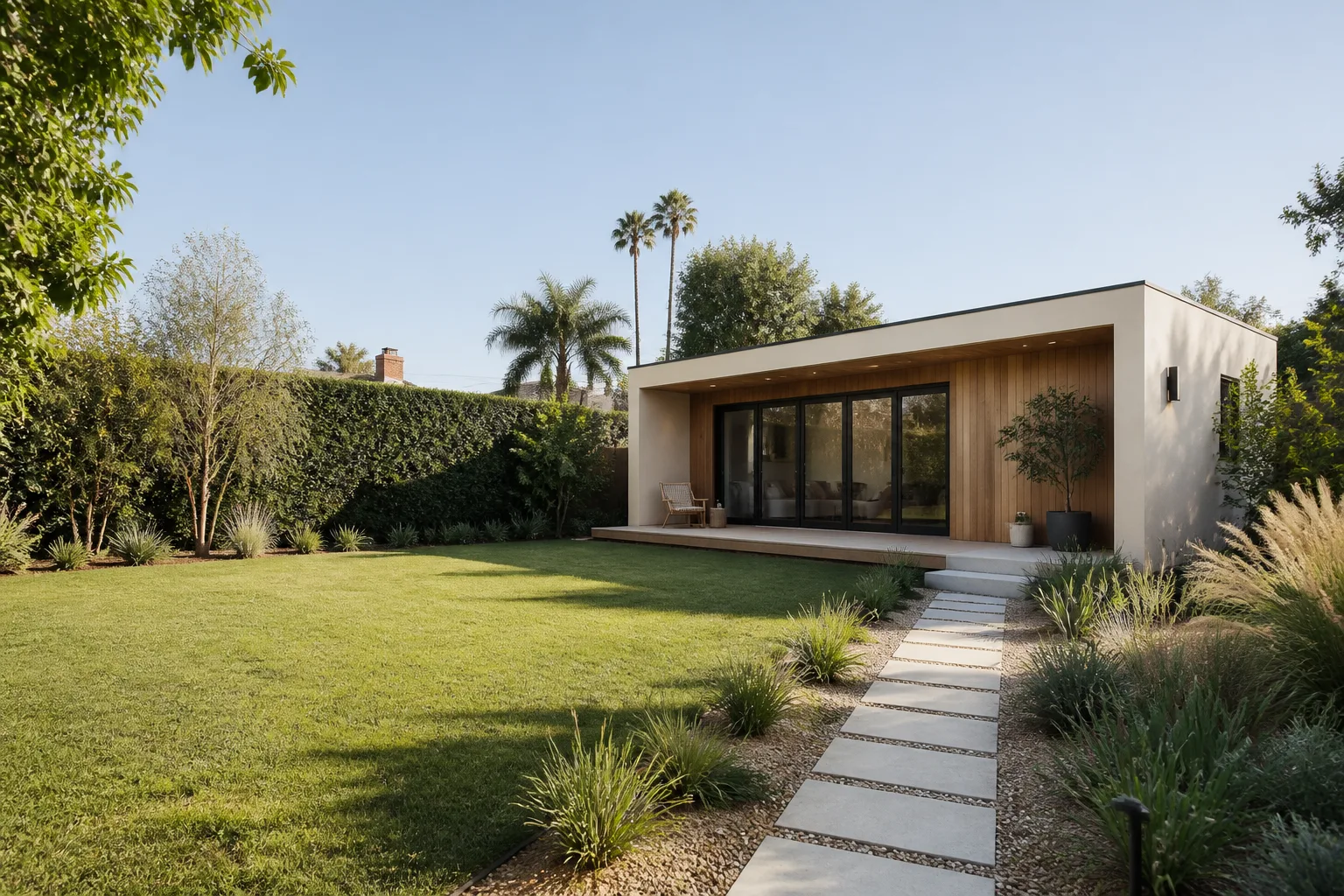
- Detached new construction ADU: Professional required for most homeowners. A detached ADU is a full house build compressed into 400 – 1,200 square feet. Foundation, framing, roofing, full electrical, full plumbing, HVAC, and exterior envelope. There is no meaningful DIY scope other than painting and landscaping at the end. This is the project type where owner-builder mistakes hurt the most.
Prefab ADU manufacturers like Mighty Buildings and Boxabl have changed the calculus somewhat for detached units. These companies build wall panels or entire modules in a factory, which removes some of the on-site framing variance. But even a prefab ADU requires site work, foundation preparation, utility connections, and finish trades. You still need a licensed contractor to coordinate the site work. What you save with prefab is framing time, not permits and liability.
The 7-Year Resale Disclosure You’re Signing Up For
California Civil Code requires sellers to disclose any structural additions or alterations completed under an owner-builder permit for seven years following completion. This is the piece of the owner-builder puzzle that most homeowners discover too late.
When you sell a home in Orange County with an owner-builder ADU inside that seven-year window, you must disclose to the buyer that you acted as owner-builder. A well-informed buyer’s agent will ask follow-up questions: Was the work inspected? Who performed the electrical? What warranty exists if something fails? If your answers are “yes, a friend, and none,” expect the buyer to negotiate price or walk away.
Even outside the seven-year window, some buyers specifically ask about owner-builder work. In a market like Orange County, where ADUs are increasingly common and buyers are informed about the difference between a professionally built unit and an owner-builder unit, this disclosure has real financial consequences. A professionally built ADU with a contractor’s warranty is a selling point. An owner-builder ADU without transferable warranties is a question mark.
This is why we tell homeowners that the DIY savings on the front end can show up as a discount on the back end. The buyer who saves $30,000 on construction today may give up $30,000 in negotiating leverage when they sell. The math only works if you stay in the home long enough to amortize the risk, and even then it’s a bet, not a certainty.
Common Mistakes to Avoid
- Assuming your homeowner’s insurance covers construction: It doesn’t. Course-of-construction coverage is a separate policy. If you’re owner-building without it, you’re self-insuring a construction site, which is a bad position.
- Hiring unlicensed subcontractors to save money: In California, unlicensed work over $500 is illegal for licensed contractors and a liability nightmare for owner-builders. The savings disappear the first time something goes wrong.
- Not checking local ADU ordinances in Orange County: Each city sets its own rules on setbacks, height limits, and parking. What’s legal in Garden Grove may not be in Laguna Beach. Check with your city before you draw anything.
- Skipping the soil report on a detached ADU: Orange County has varied soil conditions. A foundation designed without a soil report can crack within years. We’ve seen it.
- Underestimating the permit review timeline: Some Orange County building departments take 6 – 12 weeks for ADU plan review. If you’re owner-building without a drafter who knows the local code, expect plan rejections that add months.
- Treating the ADU like a shed: Even a small ADU is a residential dwelling unit under California Building Code. It needs proper egress, ventilation, insulation, and emergency escape windows. Tuff Shed makes great backyard structures, but a shed is not an ADU.
- Choosing the wrong prefab partner without local site work planning: Companies like Plant Prefab make excellent factory-built shells, but the shell still needs a permitted foundation, utility trenching, and finish work. Budget for it.
When to Call a Professional
If your ADU requires any of the following, call a licensed contractor: structural changes to an existing building, new electrical circuits or a panel upgrade, new plumbing lines or a sewer connection, a new foundation, or any work that requires engineered drawings. These aren’t judgment calls. They’re the line between a permitted ADU and a liability problem. Even if you plan to owner-build the finish work, get a professional for the bones. Lodgewick ADU Orange County offers free estimates in Orange County, and we’re happy to walk you through which parts of your project make sense as DIY and which don’t. Call (350) 203-6060 and we’ll give you our honest read.
Frequently Asked Questions
A DIY or owner-builder ADU in Orange County typically costs $150 – $250 per square foot in materials and subcontracted labor, while a professional build typically runs $300 – $450 per square foot including the contractor’s 20 – 30% overhead and profit. The DIY number, however, doesn’t include the cost of mistakes, plan rejections, or liability exposure. Most homeowners who owner-build a full ADU end up spending more in total cost and time than the sticker price suggests. Call (350) 203-6060 for an exact quote on your project, and we’ll give you a written price before any work starts.
Yes, California law allows property owners to pull an owner-builder permit and act as their own contractor on residential projects, including ADUs. However, you sign a legal attestation accepting personal liability for workers’ compensation, code compliance, and subcontractor management. You also accept a seven-year resale disclosure obligation under the California Civil Code.
No. Standard homeowner’s insurance does not cover construction activity. If you’re building as an owner-builder, you need a separate course-of-construction policy. Licensed contractors carry their own general liability insurance, which shifts that risk off your policy entirely.
Yes, most construction lenders and many HELOC agreements require a licensed general contractor on the loan for projects like ADUs. The lender needs a fixed-price contract and a licensed, bondable entity to underwrite against. Owner-builder status usually disqualifies you from construction financing, which is why most financed ADU projects are professionally built.
You can safely self-perform demo of non-structural elements, painting, finish landscaping, finish carpentry, and hardware installation without voiding permits or warranties. Structural work, electrical, plumbing, foundation work, roofing, and HVAC all require licensed tradespeople and should not be DIY’d.
A detached ADU is harder to DIY because it involves foundation work, full framing, and complete utility connections, which require licensed trades. A garage conversion is only slightly more DIY-friendly because the existing structure and foundation are already there, but the plumbing, electrical, and drywall work still require permits and professional trades. An interior JADU offers the most realistic DIY scope because it’s contained within existing conditioned space.
The Bottom Line
The DIY-versus-professional decision for an ADU in Orange County comes down to three questions: Can you handle the permit liability? Will your financing allow it? Are you willing to accept the insurance gap? If the answer to any of these is no, hire a licensed contractor for the full build and keep the cheap, low-skill finish work for yourself. The Kingswell Way, which guides every Lodgewick ADU Orange County home, is built on a simple principle: say the price before the work, show up in the window given, leave the place cleaner than found, put the guarantee in writing, and come back if it fails. That’s what a professional build looks like. If you’re weighing the decision for your property, call (350) 203-6060. We’ll give you a written price and an honest read on what’s safe to DIY and what isn’t.
Written by Russ Delmar, Owner at Lodgewick ADU Orange County, serving Orange County since 2010. Explore more guides & resources on ADU planning, construction, and care.