Last updated October 15, 2026
ADU Cost Breakdown: The Orange County Homeowner’s Reference for 2026
The $150,000 ADU quote and the $210,000 quote you received may describe the exact same 500-square-foot one-bedroom unit. The difference usually isn’t profit margin. It’s what each contractor chose to include or quietly leave out. In Orange County, site work, utility lateral upgrades, school district fees, and Title 24 energy requirements routinely add $35,000 to $55,000 to a project that looked affordable on paper. This guide breaks down 2026 costs by ADU type, finish level, and the line items most bids skip, so you can build an honest budget before you call a single contractor. For a deeper dive, see our Complete Guide to ADU in Orange County.
Quick Answer
In Orange County for 2026, a garage conversion ADU runs $80,000 to $130,000, an attached ADU $130,000 to $200,000, a detached new-construction ADU $150,000 to $280,000, and a JADU or interior conversion $40,000 to $80,000. These ranges assume you’re using a licensed Orange County ADU contractor and include standard site work, permits, and utility connections. For details on permits and inspections, read ADU Permits, Codes & Inspections in CA: What You Need to Know. If a bid comes in far below these numbers, it probably leaves out the hidden costs covered in Section 4 below.
Table of Contents
- 4.1 Cost by ADU Type: Real 2026 Orange County Numbers
- 4.2 The Five Line Items Most Orange County ADU Bids Leave Out
- 4.3 How Finish Level Moves the Number: Budget, Mid, and High-End Interiors
- 4.4 Financing Costs as Part of Your Total Project Cost
- 4.5 How to Compare Two ADU Quotes That Look Far Apart
- 4.6 Orange County Specifics: Permits, Fees, and What the Local Market Does to Your Budget
- 4.7 Prefab vs. Site-Built: What Orange County Homeowners Actually Pay in 2026
- 4.8 How Long an ADU Takes in Orange County and What Delays Cost
Cost by ADU Type: Real 2026 Orange County Numbers
Every ADU type carries a different base cost because each one starts from a different physical reality. A garage conversion already has a foundation, walls, and a roof. A detached unit needs all three built from scratch. That difference alone is worth $60,000 to $100,000 before anyone picks out a faucet.
Garage Conversion ADU: $80,000 to $130,000
A garage conversion, or garage-to-ADU, takes your existing garage shell and turns it into livable space. You keep the slab, the framing, and the roofline. What you’re paying for is bringing the structure up to residential code: insulation in walls that likely have none, drywall, a new subfloor over the concrete, plumbing rough-in for a bathroom and kitchenette, electrical upgrades, and heating and cooling. In Orange County, the mild coastal climate means you can often use a ductless mini-split for HVAC instead of running new ductwork, which saves $4,000 to $8,000 compared to inland climates with harsher temperature swings. But older garages in Anaheim, Santa Ana, and Garden Grove frequently have slabs that sit below grade, which means adding a moisture barrier and potentially re-sloping for drainage. That’s a $6,000 to $12,000 item that never appears in a brochure estimate. If you want to understand the full scope of a conversion, our Garage Conversion Contractor in Orange County page explains the process step by step.
Attached ADU: $130,000 to $200,000
An attached ADU is a new living unit built as an addition to your existing home. Think of it as a small apartment that shares one wall with your house. You’re paying for new foundation work, new framing, new roofing tied into your existing roofline, and all-new mechanical systems. The shared wall saves some money compared to a fully detached unit, maybe $15,000 to $25,000, because one wall of structure already exists. But you’ll also pay for the privilege of tying into your home. Electrical panels often need upgrading to 200 amps, which runs $3,000 to $6,000 in Orange County. Fire separation requirements between the main house and the ADU add another $4,000 to $9,000. And because Orange County is in seismic zone territory, shear wall requirements and foundation bolts add $5,000 to $10,000 that casual cost guides never mention. For a deeper look at attached unit pricing and process, see our Home Addition Contractor in Orange County page.
Detached New Construction ADU: $150,000 to $280,000
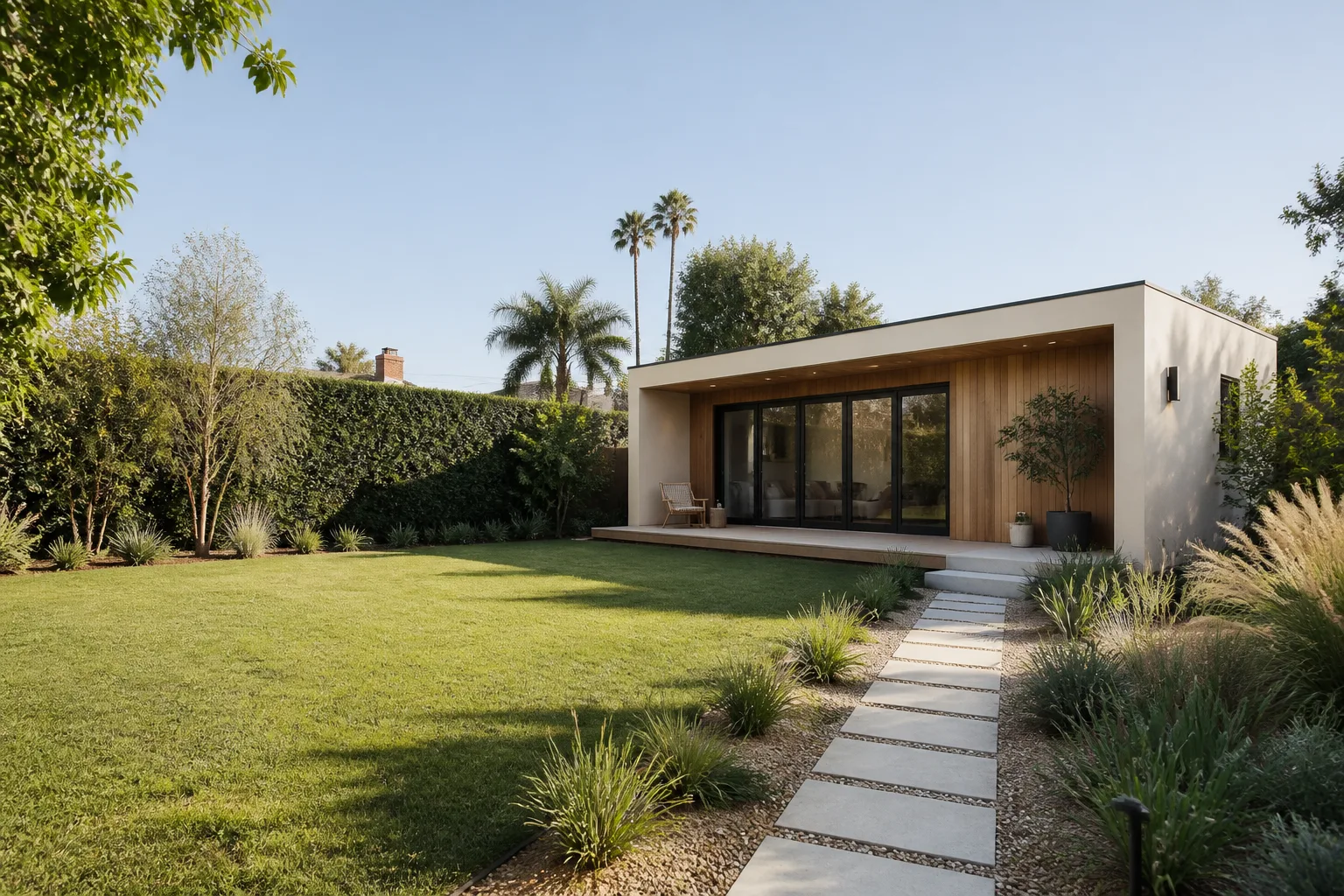
A detached ADU is a standalone small house in your backyard. It needs everything: excavation, a new foundation, all four walls, a roof, running utilities from the street or main house, and its own address. This is the most expensive ADU type and the most flexible. You can build up to 1,200 square feet in most Orange County jurisdictions, though many homeowners stick to 500 to 800 square feet for budget reasons. At 500 square feet, expect $150,000 to $190,000 for a clean, code-compliant build with mid-range finishes. At 800 square feet with two bedrooms and higher-end interior choices, that number climbs to $220,000 to $280,000. Fire sprinklers, now required in many California ADUs, add $8,000 to $15,000. Trenching for a separate gas line, if you choose gas appliances, adds $5,000 to $12,000 depending on how far the unit sits from the main. For the complete breakdown of what goes into a detached build in this market, start with our ADU Builders in Orange County page.
JADU / Interior Conversion: $40,000 to $80,000
A JADU, or Junior Accessory Dwelling Unit, converts space already inside your home, like an attached garage, a finished basement, or an unused bedroom suite, into a compact independent living unit of 500 square feet or less. The JADU path is cheaper because you’re working with existing interior space. No foundation, no exterior walls, no roof. Your money goes to a kitchenette, a separate entrance (required), a bathroom (which can sometimes be shared with the main house under recent California law), and sound insulation between the JADU and the rest of the home. In Orange County, a simple JADU in an existing attached garage can run as low as $40,000 when the garage is already finished and drywalled. But when the space needs new electrical, plumbing, and a separate entrance cut through an exterior wall, $70,000 to $80,000 is realistic. Keep in mind: a JADU cannot be rented separately if you decide to rent the main house, and it counts against your total JADU plus ADU square footage. Those restrictions shape what a JADU is worth to you versus what it costs.
The Five Line Items Most Orange County ADU Bids Leave Out
Every contractor wants to look affordable on paper. Some do it honestly by scoping conservatively. Others do it by omission, leaving out categories they know every project needs but hoping you won’t notice until the change order lands. Here are the five items we see missing from Orange County ADU bids more than any others. Watch for these ADU Warning Signs: A Orange County Homeowner’s Reference Guide.
- Utility lateral upgrades. Your existing sewer lateral and water service were sized for one house. Adding an ADU often requires upsizing or replacing them, especially in older Orange County neighborhoods like the historic districts of Orange, Fullerton, and Tustin, where clay sewer pipes from the 1950s and 1960s are common. Running a new sewer lateral from the ADU to the street can cost $8,000 to $18,000 depending on depth, distance, and whether the street connection needs a city inspection and permit. This line appears in fewer than half the bids we see.
- School district fees. Yes, building an ADU in Orange County can trigger school impact fees. The amount varies by district. Irvine Unified, Capistrano Unified, and Orange Unified each assess fees differently, and while California law has reduced or exempted some residential ADU fees, larger detached units and attached ADUs over certain square footage thresholds can still face levies of $3,000 to $12,000. A bid that doesn’t list this as a line item either hasn’t checked with the district or plans to surprise you later.
- Soils report. If your detached ADU sits on expansive clay, which is common in parts of north Orange County and the foothill areas, a soils report may be required before the foundation can be designed. That report costs $3,000 to $6,000 and can lead to deeper footings, a post-tension slab, or foundation over-excavation that adds another $8,000 to $20,000. No one puts this in a preliminary quote, but someone has to pay for it.
- Title 24 energy calculations. California’s energy code requires a Title 24 energy report and compliance certificate for every ADU. The report itself is $1,500 to $3,500 from an energy consultant. The compliance measures it triggers are more expensive: solar panels (required on detached ADUs), upgraded insulation, low-E windows, and high-efficiency HVAC equipment. All in, Title 24 compliance adds $12,000 to $25,000 to an Orange County ADU, and it’s rare to see more than a line item marked “Title 24” with no dollar figure attached.
- Interior furnishing rough-ins. A bid might say “kitchen and bath included” but not specify what that means. Does the kitchen include cabinets, countertops, sink, and a range? Does the bath include tile, a vanity, and a shower enclosure? In many cases, we see bids where “kitchen included” means plumbing rough-in only, and the actual cabinets, counters, and appliances are the homeowner’s responsibility after the fact. That gap is worth $12,000 to $25,000. When you review a bid, ask the contractor to list every fixture by name and confirm whether appliances are included.
How Finish Level Moves the Number: Budget, Mid, and High-End Interiors
On a 500-square-foot one-bedroom ADU, finish level alone can swing the total cost by $45,000 to $70,000. That’s nearly half the base cost of a garage conversion. Here’s what each tier looks like in 2026 Orange County pricing and where the dollars actually go.
| Finish Level | Interior Cost for 500 sq ft | What You Get |
|---|---|---|
| Budget | $18,000 to $25,000 | Stock cabinets from big-box suppliers, laminate counters, vinyl plank flooring, standard fiberglass shower enclosure, basic light fixtures, economy appliances. Durable but no frills. |
| Mid-Range | $28,000 to $40,000 | Shaker-style semi-custom cabinets, quartz counters, LVP or engineered wood flooring, tile shower surround, recessed lighting, name-brand mid-tier appliances like GE or Whirlpool. |
| High-End | $45,000 to $70,000+ | Custom cabinetry, natural stone or premium quartz counters, hardwood flooring, full tile shower with glass enclosure, designer lighting, high-efficiency appliances like Bosch or Cafe, custom closet systems. |
The single largest interior line item is the kitchen. Even in a small ADU, a kitchen with semi-custom cabinets, quartz counters, and a full appliance package runs $12,000 to $18,000. The same footprint with stock cabinets and laminate counters can come in around $7,000. Bathrooms follow the same pattern, $6,000 on the low end to $18,000 for a fully tiled shower with a glass door. Flooring across 500 square feet ranges from $2,500 for basic vinyl plank to $9,000 for hardwood. Lighting and electrical fixtures add $1,800 to $5,000 depending on how many recessed fixtures and dimmers you choose.
Our advice to Orange County homeowners: if you’re building to rent the unit, mid-range finishes are the sweet spot. They hold up to tenant wear, they’re easy to clean and replace, and they photograph well when it’s time to list. If you’re building for family, like an aging parent or an adult child, choosing finishes you’d want in your own home usually means mid-range or upper-mid. High-end finishes in a rental unit rarely pay back their cost in higher rent, especially in Orange County markets where rent is tied more to square footage and location than to countertop material.
Financing Costs as Part of Your Total Project Cost
Most cost guides treat financing as an afterthought. It’s not. A $180,000 ADU financed over 20 years at 2026 rates can cost $120,000 to $160,000 in interest, depending on your lender and loan product. That interest is part of the project cost, and it changes which ADU type makes sense for your situation. Here are the three main financing paths Orange County homeowners use and what each one costs in 2026.
- ADU construction loan. Purpose-built for ADUs, these loans fund the project in draws as work completes and then convert to permanent financing. Expect rates in the 6.5% to 8.5% range for 2026, with closing costs of 2% to 4% of the loan amount. The advantage is that the loan is sized to the ADU’s appraised value, which often covers 80% to 90% of construction cost. The disadvantage is that draw administration takes paperwork and the lender holds the schedule.
- HELOC, or Home Equity Line of Credit. If you have meaningful equity in your Orange County home (and many homeowners who bought before 2020 do), a HELOC can fund the ADU at rates tied to the prime rate, typically 7% to 9% in 2026. You pay interest only on what you draw, which is useful when payments to the contractor are staggered. The risk: variable rates can climb, and your home is the collateral. A $180,000 HELOC balance at 8% costs $1,200 per month in interest alone during the construction phase.
- Cash-out refinance. This replaces your existing mortgage with a larger one and gives you the difference in cash for the ADU. It only makes sense when your current mortgage rate is higher than 2026 refi rates, which for homeowners who bought in 2022 and 2023 can be true. Closing costs run $4,000 to $8,000. The ADU becomes part of a 30-year mortgage payment, spreading the cost over the longest possible timeline and lowering the monthly hit.
Adding $30,000 of financing cost to a $100,000 garage conversion changes the real number to $130,000. That’s the number to compare against what the ADU will earn or save you each month. A well-built one-bedroom ADU in Orange County rents for $1,800 to $2,600 per month depending on the city. In Irvine, Costa Mesa, and Huntington Beach, rental demand is strong enough that even at current rates, an ADU can cash-flow modestly from year one. In other Orange County markets, it breaks even for the first several years and pays off through property appreciation and flexibility. Run the numbers with financing included, not just the construction quote.
How to Compare Two ADU Quotes That Look Far Apart
Two Orange County ADU bids for the same project can differ by $60,000 and still both be honest. The difference lives in scope, finish level, and how thoroughly each contractor priced the hard costs. Here’s how to find the real delta.
- Ask both contractors to break out the same categories. The categories that should appear on every bid: demolition and site prep, foundation, framing, roofing, windows and doors, plumbing, electrical, HVAC, drywall and insulation, flooring, kitchen, bathroom, paint, site utilities, permit fees, and design or engineering. If one bid is missing entire categories, that’s your $60,000 answer right there.
- Compare finish allowances line by line. One contractor may have $35,000 for interior finishes at mid-range spec while another has $18,000 at budget spec. Neither is wrong, but they’re not bidding the same building. Ask each contractor to list cabinet brand and grade, countertop material, flooring type, and appliance tier. That’s the only way to see whether you’re comparing apples to apples.
- Look at who carries the contingency. Some contractors build a 5% to 10% contingency into every line item because they know change orders poison trust. Others bid the absolute base number and then write change orders for anything unexpected. The base-number bid will look cheaper and end up more expensive. Ask the contractor to show you their written price policy and whether their bid price is the price you’ll pay if scope doesn’t change. At Lodgewick ADU Orange County, we put a written price in front of every homeowner before any work starts. No price changes at the door. That’s The Kingswell Way, and it’s been the standard since 2010.
- Check the warranty before you sign. A $15,000 cheaper bid with a one-year warranty that the contractor may or may not honor is not cheaper than a bid with a written guarantee that covers the work for a full year with a free return visit if something fails. Ask to see the guarantee in writing. If they won’t put it in the contract, the low number means nothing.
- Confirm who pulls permits and schedules inspections. Every legitimate ADU in Orange County needs a building permit, and most cities require multiple inspections: foundation, framing, plumbing, electrical, final. A contractor who includes permit fees and inspection scheduling in the bid is costing you less in time and hassle than one who charges for them separately or expects you to manage them yourself.
Orange County Specifics: Permits, Fees, and What the Local Market Does to Your Budget
Orange County isn’t one market. It’s 34 cities plus unincorporated county areas, each with its own planning department, permit fees, and timelines. What costs $4,000 in permits in one city can cost $9,000 in another. What takes 10 weeks to permit in one jurisdiction takes 16 in another. These differences matter to your total cost because every week of delay is a week you’re paying carrying costs on the financing or missing rental income.
Permit fees in Orange County for an ADU typically run $6,000 to $14,000 depending on the city and the project size. That includes building permit, plan check, and utility connection fees. Some cities, like Irvine and Newport Beach, have dedicated ADU review processes that move faster but charge more. Others route ADUs through the standard residential addition process, which is slower but cheaper on paper. Fast permitting saves you money in loan interest and lost rent even when the fee itself is higher.
Design and engineering for an Orange County ADU runs $8,000 to $18,000. That includes architectural drawings, structural engineering, the Title 24 energy report, and any soils or drainage studies your site requires. This is not the place to save money. A cheap drafting service that doesn’t know Orange County code requirements will cost you in plan check rejections, each of which adds weeks and $500 to $2,000 in resubmission fees. We see this in our work as ADU Builders in Orange County regularly: a set of plans drawn to generic California code that fails Orange County’s stricter fire, seismic, and energy requirements on first submittal.
Orange County’s climate works in your favor on one cost category: HVAC. The coastal climate means a ductless mini-split system sized for a 500-square-foot ADU runs $4,000 to $7,000 installed, significantly less than full central air with ductwork. For attached ADUs that tie into the main home’s system, the cost can be lower still, though you’ll need a separate zone and thermostat for the unit. In inland Orange County areas like Yorba Linda, Anaheim Hills, and Rancho Santa Margarita, where summer temperatures regularly hit the high 90s, consider oversizing the unit slightly and adding a ceiling fan. The $800 premium beats a tenant who can’t sleep in August.
Prefab vs. Site-Built: What Orange County Homeowners Actually Pay in 2026
Prefab ADUs get a lot of press, and for good reason. Companies like Abodu and Cover have built strong reputations for delivering factory-built units with predictable pricing and faster timelines. But the sticker price on a prefab unit is not the total cost, and in Orange County the gap between prefab and site-built is narrower than the marketing suggests.
A 500-square-foot one-bedroom Abodu unit, delivered and set on your Orange County lot, typically runs $190,000 to $240,000 all-in for 2026. That includes the factory build, delivery, craning, foundation, utility hookups, and permit fees. A comparable site-built detached ADU from a quality Orange County contractor runs $150,000 to $220,000 with mid-range finishes. So prefab carries a premium. What you’re buying with that premium is speed: a Abodu unit can be delivered and set in weeks after site prep versus four to seven months of on-site construction. If you’re renting the unit, the earlier rent start date can offset the premium. If you’re building for family with no rental income, the math often favors site-built.
Dvele takes a different approach, building higher-performance units with integrated smart-home systems and net-zero energy capabilities. Their pricing starts higher, often $250,000 and up for a one-bedroom, reflecting the energy performance and the technology package. For an Orange County homeowner who values resilience and long-term operating efficiency, that number can make sense. Boxabl offers a different value proposition entirely: compact factory-built units at lower price points, but the product line is geared toward smaller units and may require more site work to feel like a finished home with the curb appeal Orange County buyers and renters expect.
If you go prefab, budget for site work separately. The crane delivery requires a flat, accessible area with no overhead obstructions, which on many Orange County lots means tree trimming, temporary fence removal, or working with a narrow side yard. Those items add $3,000 to $8,000. Utility connections from the prefab unit to your existing service are usually not included in the factory price. And you still need the same permits, the same Title 24 report, and the same inspections. Our team at Lodgewick ADU Orange County home has hands-on experience with Abodu, Cover, Dvele, and other leading prefab manufacturers, and we’re glad to match the right system to your lot and budget rather than pushing one approach on every project.
How Long an ADU Takes in Orange County and What Delays Cost
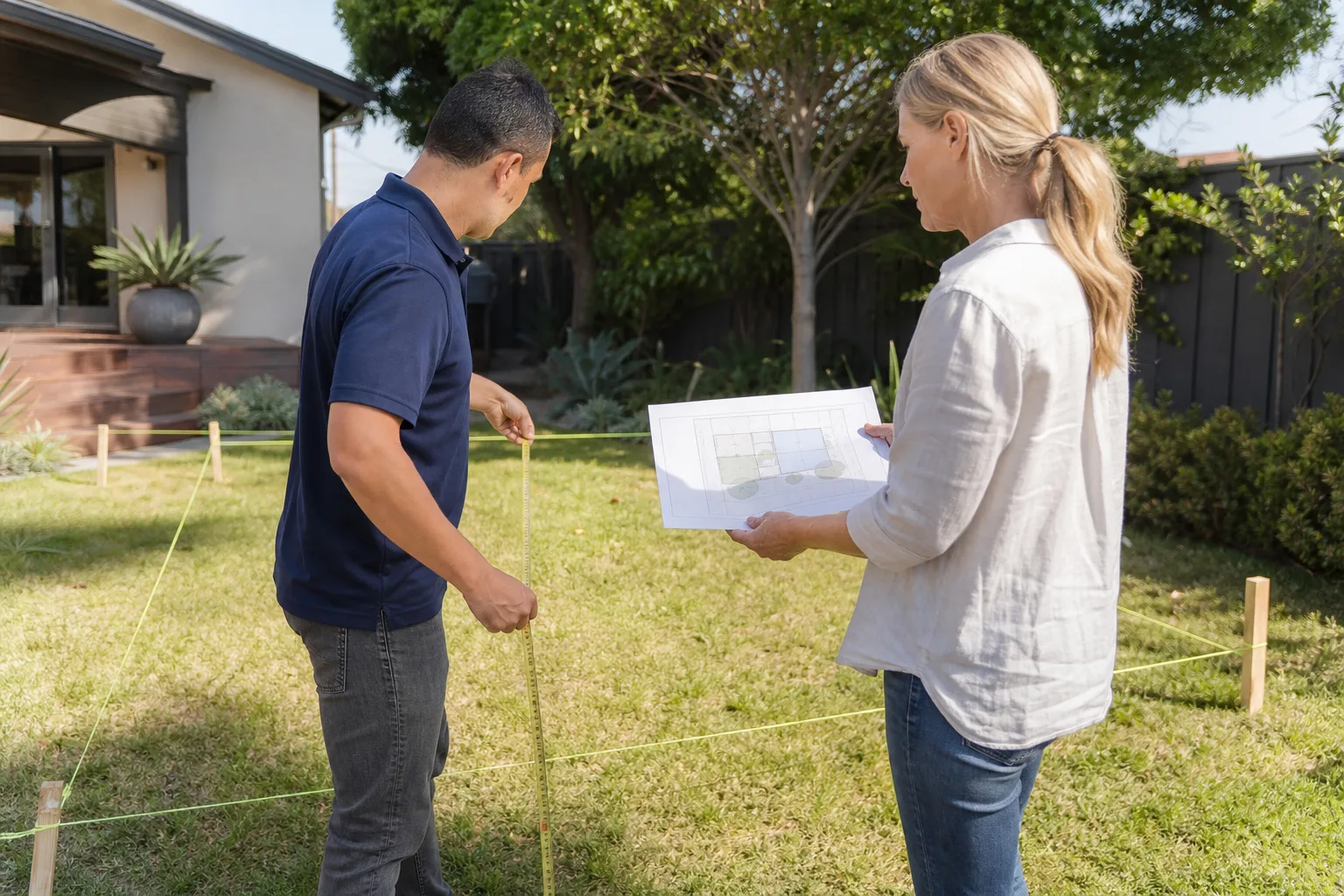
Time is money, and in Orange County ADU construction, time is where a lot of hidden cost hides. Here’s a realistic timeline for a detached 500-square-foot ADU in 2026:
- Design and engineering: 4 to 8 weeks. Architectural plans, structural engineering, Title 24 report. Rushing this step produces plan check rejections, which resets the clock.
- Plan check and permitting: 8 to 16 weeks. This varies more by city than by project. Some Orange County cities issue ADU permits in under 60 days. Others take 4 months or more during busy seasons. You can’t rush the planning department, but a permit expediter familiar with your specific city can save a month, and their $2,000 to $4,000 fee often pays for itself in carrying costs.
- Site prep and foundation: 2 to 4 weeks. Excavation, formwork, rebar, pour, cure. Weather delays are rare in Orange County, but not unheard of in winter months.
- Framing to drywall: 6 to 10 weeks. This is the visible construction phase where you’ll see the structure rise.
- Interior finishes: 4 to 8 weeks. Cabinets, counters, flooring, paint, fixtures, appliances.
- Final inspections and occupancy: 2 to 4 weeks. Utility connections, final sign-off from the city, and handing you the keys.
Total: roughly 6 to 9 months from signed contract to occupancy for a detached ADU. Garage conversions run a month or two faster because the shell already exists. JADUs can complete in 3 to 5 months. Every month of delay on a rental ADU costs you $1,800 to $2,600 in lost rent. Every month of delay on a financed ADU costs you interest on money you’ve already borrowed. That’s why the contractor’s schedule commitment matters as much as their price. Ask for a written timeline with milestones. Ask what happens if they miss one. At Lodgewick ADU Orange County, every project operates under The Kingswell Guarantee, which includes a defined arrival window and a written commitment on timeline as well as price.
Common Mistakes to Avoid
- Signing a bid without a line-item breakdown. A single number tells you nothing. Demand the breakdown by category, or you can’t compare quotes, catch omissions, or hold anyone accountable when a line item balloons.
- Ignoring utility lateral condition. Orange County homes built before 1980 often have original sewer laterals. Tying a second unit into a failing lateral means a backup that affects both units. The $8,000 to $18,000 replacement is cheaper than the emergency repair plus water damage.
- Pricing the ADU without financing cost. Interest is part of the project cost. A $180,000 ADU at 7.5% over 20 years costs about $150,000 in interest. That number belongs in your budget from day one, not after closing.
- Choosing finishes for resale instead of use. High-end finishes in a rental unit don’t increase rent proportionally in most Orange County markets. Spend where durability and low maintenance matter, not where a future buyer might theoretically care.
- Skipping the soils check on a detached build. Expansive clay under a slab foundation in north Orange County can mean cracked floors and sticking doors within a few years. A $3,000 to $6,000 soils report is cheap insurance against a $40,000 foundation repair.
- Not getting the guarantee in writing. A verbal promise to come back and fix problems is worth the paper it’s printed on, which is none. The written guarantee, with a defined period and a defined remedy, is the only version that means anything. Ask to see it before you sign.
When to Call a Professional
You need an ADU professional when the project involves anything beyond cosmetic work. An ADU adds plumbing, electrical, structural, and fire-safety systems to your property. A mistake in any one of those creates a risk to your family, your tenant, and your home’s resale value. Specifically, call a professional if your project requires a new foundation, utility lateral work, electrical panel upgrade, roof tie-in for an attached ADU, or any structural modification. Even if you plan to manage the project yourself, a professional consultation before you begin can catch the five hidden line items covered above and save you five figures. Lodgewick ADU Orange County offers free estimates throughout Orange County. Call (350) 203-6060 to schedule yours.
Frequently Asked Questions
In Orange County for 2026, expect to pay $80,000 to $130,000 for a garage conversion ADU, $130,000 to $200,000 for an attached ADU, $150,000 to $280,000 for a detached new-construction ADU, and $40,000 to $80,000 for a JADU or interior conversion. These ranges include standard site work, permits, and utility connections. Call (350) 203-6060 for an exact quote on your specific property because lot conditions and city requirements vary significantly across Orange County.
A legitimate contractor’s price should not change unless the scope changes. That’s why we put every commitment in writing before work begins at Lodgewick ADU Orange County. Our written price policy means no price changes at the door. If a contractor refuses to put the price in writing, treat that as a warning sign. Call (350) 203-6060 for a written estimate with a line-item breakdown you can hold us to.
Yes. Every ADU in Orange County requires a building permit, and most cities require multiple inspections throughout the project. We handle permit applications, plan check submittals, inspection scheduling, and final sign-off as part of the project. A contractor who asks you to pull permits yourself is shifting legal and financial risk to you. Our team has been managing Orange County permits for ADUs, garage conversions, and home additions since 2010.
A detached ADU typically takes 6 to 9 months from signed contract to occupancy in Orange County. A garage conversion runs 5 to 7 months. A JADU can complete in 3 to 5 months. The biggest variable is city permitting time, which ranges from 8 to 16 weeks depending on which Orange County jurisdiction you’re in. We provide a written timeline with milestones on every project.
A JADU, or Junior Accessory Dwelling Unit, is a compact living unit of 500 square feet or less created inside your existing home, often from an attached garage or unused interior space. JADUs are cheaper than full ADUs, typically $40,000 to $80,000 in Orange County, because they don’t require new foundations, walls, or roofs. However, JADUs cannot be rented separately if you rent the main house, and they come with size and occupancy restrictions.
Most single-family residential lots in Orange County qualify for at least one ADU under California state law, which overrides many local zoning restrictions. Properties with sufficient rear or side yard space can usually accommodate a detached ADU, while smaller lots may be limited to garage conversions or JADUs. Your specific lot’s constraints determine what’s buildable and at what cost, which is why a free on-site evaluation is the most useful next step. Call (350) 203-6060 and we’ll take a look at your property.
The Bottom Line
An ADU in Orange County is a six-figure decision that starts with a number you can trust. The ranges in this guide, $40,000 to $280,000 depending on type, are real 2026 Orange County numbers that include the line items most bids hide. Your job is to get a written, line-item price and a written guarantee before you sign anything. Know your financing cost from day one. Know your finish level and what it costs. Know that the guarantee is only worth what’s in writing. The Kingswell family has been running Lodgewick ADU Orange County on that principle since 2010: written price first, defined arrival window, clean job site, written guarantee on every project. A lodge, after all, is a small house on a larger property. That’s exactly what we build. Explore more guides & resources on ADU planning and construction.
Written by Russ Delmar, Owner at Lodgewick ADU Orange County, serving Orange County since 2010.