Last updated October 15, 2026
The Complete Guide to ADU in Orange County
Orange County issued over 2,800 ADU permits in 2023, and a meaningful share of those projects ran over budget or over schedule because the homeowner skipped step two and went straight to step five. They fell in love with a floor plan before checking whether their lot could actually support it, or signed a contract before understanding how Orange County’s patchwork of city-level rules would affect their build. This guide maps the exact sequence: lot check, budget, permit path, contractor selection, and move-in. Follow the order, and you’ll save yourself months of frustration and thousands of dollars. Skip a step, and you’ll meet the same fate as the homeowners who called us a year into a stalled project, asking if it was too late to fix.
Quick Answer
Building an ADU in Orange County costs between $80,000 and $280,000 depending on whether you convert a garage, add onto your home, or build a detached unit from scratch, and the process takes 8 to 18 months from first sketch to final inspection. The right sequence is: verify your lot qualifies, set a realistic budget with a 15% contingency, choose between a garage conversion, attached addition, or detached new build, then select a contractor who puts a written price and scope in front of you before work begins. Most homeowners who get stuck in Orange County didn’t pick the wrong floor plan. They picked the wrong order of operations.
Table of Contents
- Step 1: How to Run a Free Lot Feasibility Check
- Step 2: Real ADU Costs by Type in Orange County
- Step 3: The Permit Sequence in Plain Order
- Step 4: How to Pick an ADU Contractor (Not a Kitchen Remodeler)
- Step 5: The One Written Document That Protects Your Budget
- Step 6: Design and Material Choices That Affect Your Timeline
- Step 7: From Foundation to Move-In – The Real Timeline
- Common Mistakes to Avoid
- When to Call a Professional
- Frequently Asked Questions
- The Bottom Line
Step 1: How to Run a Free Lot Feasibility Check
Before you spend a dollar on design, you need to know whether your Orange County lot can legally host an ADU. The good news: California state law has made ADUs legal on nearly every single-family residential lot in the state, and Orange County cities like Anaheim, Irvine, and Santa Ana have had to fall in line. The bad news: each city interprets the state mandate slightly differently, and your specific lot’s shape, slope, and existing structures can create constraints that no state law can override.
Start with these free checks, in this order:
- Look up your parcel on your city’s GIS map. Anaheim, Irvine, Santa Ana, Huntington Beach, and Garden Grove all maintain online parcel viewers. Search your address and confirm your zoning designation. You want an R-1, R-2, or equivalent residential zone. If your lot is zoned for agriculture or commercial, your ADU path gets more complicated.
- Check your city’s ADU ordinance page. Each city publishes its own ADU handbook or ordinance summary. Irvine’s is famously detailed, with specific setback language for corner lots. Santa Ana’s handbook is more streamlined, reflecting the city’s push to encourage ADUs as a housing solution. Read the setback rules for your zone – this tells you how close to the property line you can build, and that number determines whether a detached ADU fits at all.
- Identify your utility connection points. Walk your lot and note where your electrical panel, water meter, and sewer lateral sit. A detached ADU needs its own connections or a clearly defined sub-feed from the main house. If your panel is on the opposite side of the lot from where the ADU would go, you’re looking at trenching costs that can add $8,000 to $15,000 to your budget.
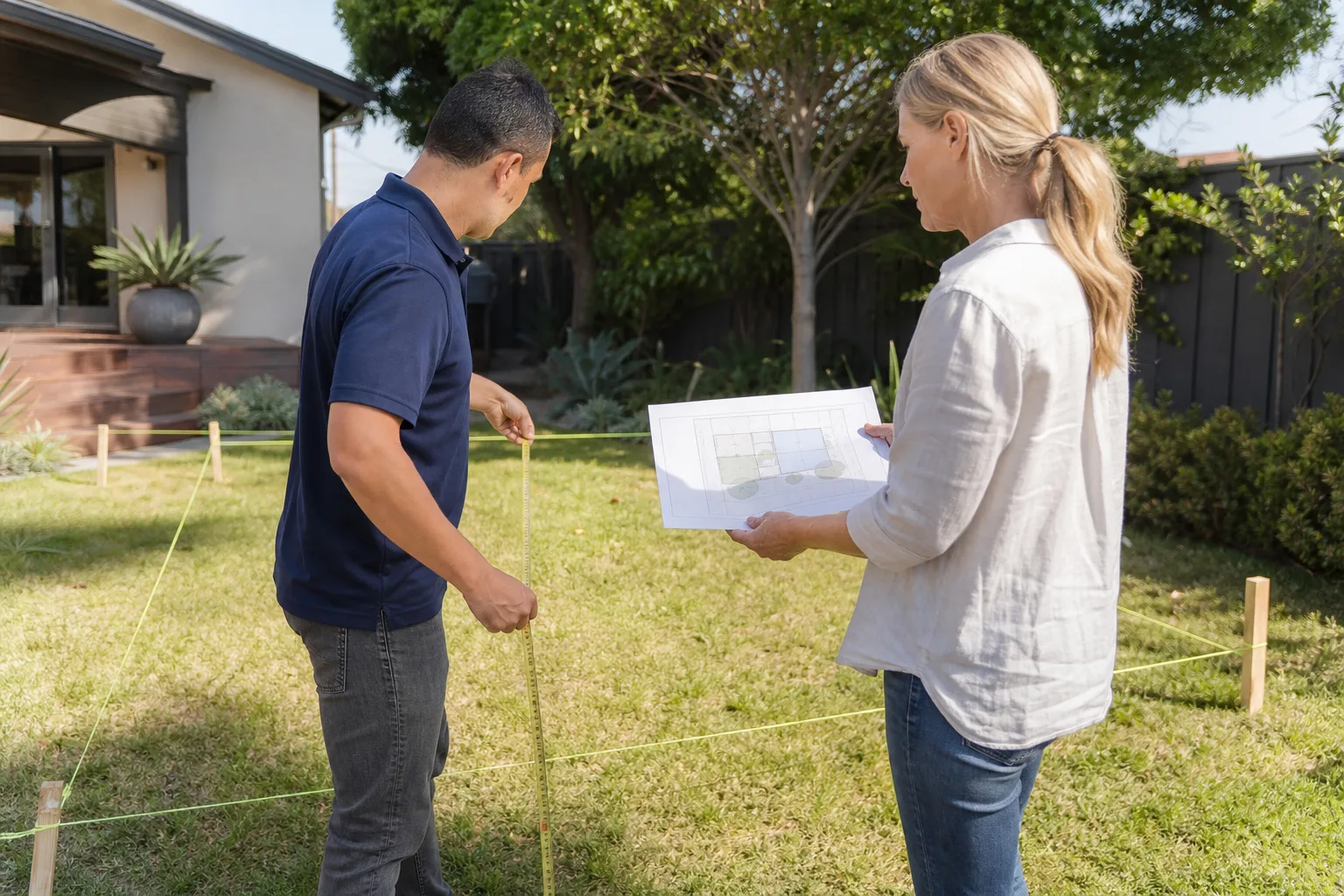
- Measure your actual usable space. Don’t trust your lot dimensions from memory. Use a tape measure or a free lot-measuring app to confirm the buildable area after setbacks. In Anaheim, for example, a detached ADU in a rear yard typically needs a 4-foot rear setback and 4-foot side setbacks, though state law caps local setback requirements at 4 feet for most ADU situations.
- Run the “tree check.” Mature trees on your lot are protected in many Orange County cities. A 60-year-old oak or sycamore in the path of your ADU can trigger a lengthy arborist review and a costly permit amendment. Identify trees near the proposed build zone before you get attached to a floor plan.
Our team at Lodgewick ADU Orange County has walked hundreds of Orange County lots, and we can tell you this: the lot check takes about an hour and is completely free if you do it yourself. The homeowners who skip it are the ones who pay a designer $4,000 for plans that the city rejects on the first submittal because the setback was wrong by 18 inches. Start with the lot. Everything else follows.
If you’re considering a garage conversion as your ADU path, the lot check is even more important, because the garage already exists. A garage conversion contractor in Orange County can tell you quickly whether your existing garage’s foundation, walls, and roofline can support a residential conversion or whether you’re better off starting fresh.
Step 2: Real ADU Costs by Type in Orange County
You should know your budget range before you call a single contractor. Orange County construction costs run higher than the national average, driven by permit fees, labor rates, and local material costs. Here are the real ranges we see across Orange County projects, as of 2024 and into 2025:
- Garage conversion: $80,000 to $130,000. This is your lowest-cost path because the structure already exists. You’re paying for foundation upgrades, insulation, drywall, electrical, plumbing rough-ins, a bathroom, a kitchenette, and finishes. The catch: you lose your garage, and many Orange County homeowners underestimate how much they value that storage and parking space.
- Attached addition: $130,000 to $200,000. This is a new living space attached to your existing home, sharing at least one wall. It costs more than a garage conversion because you’re building new foundation, walls, and roof, but it costs less than a detached unit because you’re not running new utility lines across the yard and you’re not building a completely independent structure.
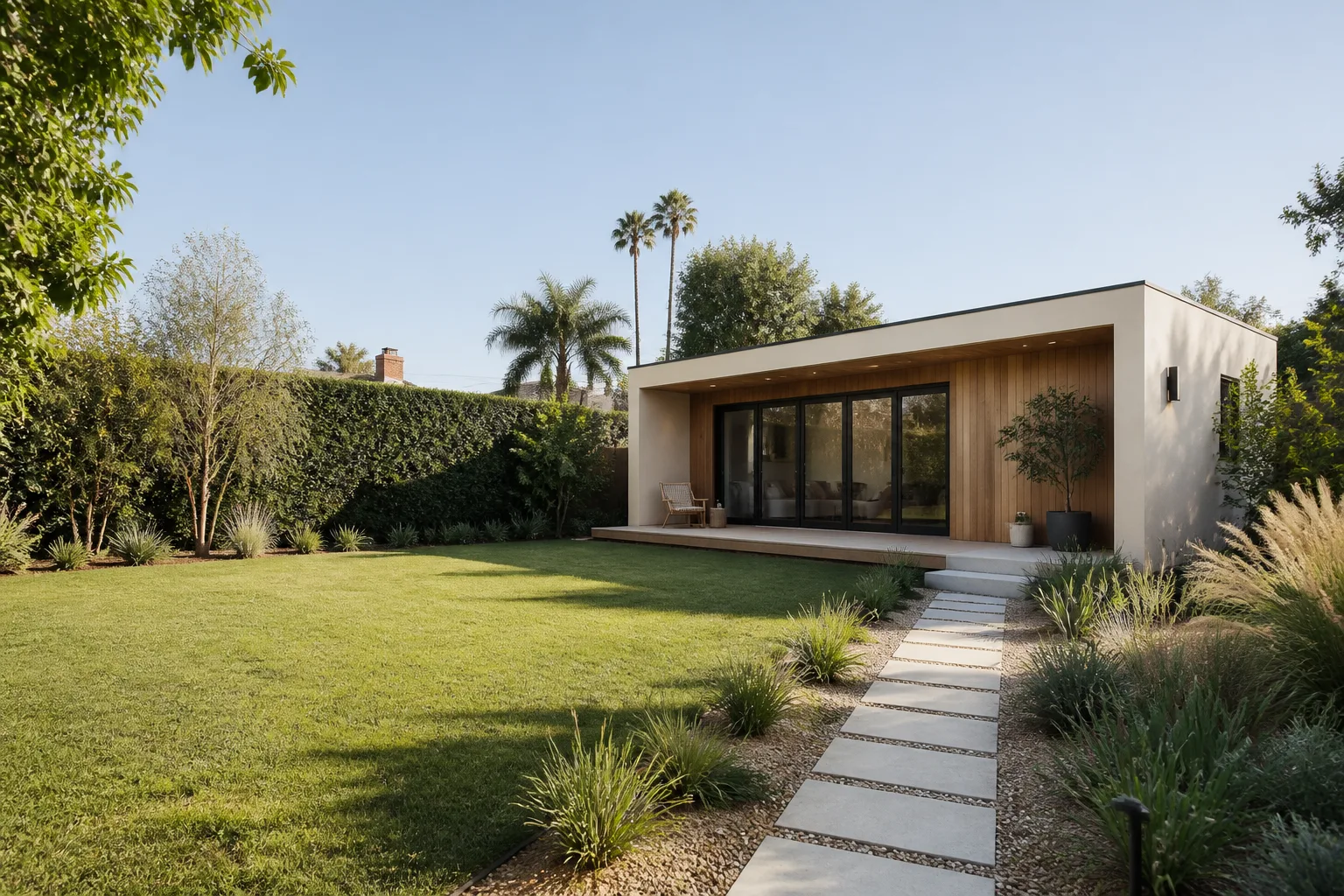
- Detached new build: $150,000 to $280,000. This is the classic backyard ADU – a standalone structure with its own foundation, walls, roof, and utility connections. The wide range reflects size (a 400-square-foot studio costs less than an 800-square-foot two-bedroom) and site conditions (flat lots with easy utility access cost less than sloped lots with tree issues).
These numbers include design, permits, labor, materials, and standard finishes. They do not include upgrades like premium appliances, custom cabinetry, or high-end flooring, which can add $15,000 to $40,000 on top. They also do not include site work surprises: a failed foundation inspection on a garage conversion, a buried septic tank you didn’t know about, or a drainage issue that surfaces only after excavation. Budget a 15% contingency line item. If you don’t use it, you keep it. If you do use it, you’re not scrambling.
For a deeper look at where these numbers come from and what drives them, see our full guide from ADU builders in Orange County.
Step 3: The Permit Sequence in Plain Order
The Orange County permitting process confuses homeowners because no one explains the order. You don’t just “pull a permit” and start building. You move through a sequence, and each step has a gatekeeper. Here’s the order:
- Pre-application meeting (pre-app). Most Orange County cities offer a free or low-cost meeting with a city planner before you submit formal plans. This is where you present a rough site plan and ask pointed questions about your specific lot: setbacks, tree protections, utility requirements, and any city-specific overlays. Irvine and Anaheim both schedule pre-app meetings within two to three weeks of request. Santa Ana has a streamlined pre-app process for ADU projects under 800 square feet.
- Plan check. You submit your architectural drawings, structural calculations, and site plan to the city’s building department. The plan checker reviews for code compliance. Expect comments. First-submittal rejections are common, not because you hired a bad designer, but because Orange County plan checkers are thorough. Address every comment, resubmit, and expect to do this two to three times before approval.
- Building permit issuance. Once plans are approved and you’ve paid the permit fees, the city issues your building permit. This is your formal authorization to start construction. In Orange County, ADU permit fees typically run $3,000 to $8,000 depending on the city and project size. Some cities, like Santa Ana, have reduced or waived certain ADU permit fees in recent years to encourage construction.
- Utility hookups. Midway through construction, your contractor coordinates with the utility companies – Southern California Edison for electrical, the local water district, and the sewer agency – to establish connections for the ADU. This step requires scheduling inspections with each utility, and the timing is outside your contractor’s direct control. Utility delays are the single biggest schedule killer on Orange County ADU projects.
- Final inspection. When construction is complete, the city sends a building inspector to verify the work matches the approved plans. Pass this inspection and you receive your certificate of occupancy, which is the legal document that allows someone to live in the ADU.
What can you prep yourself? The pre-app meeting and the plan check are steps where an organized homeowner saves real time. Have your lot measurements, tree locations, and utility connection points documented before the pre-app. Respond to plan-check comments within 48 hours, not two weeks later. The homeowners who treat permitting as a passive process are the ones who watch their project sit on a desk for three months.
If the permitting sequence feels overwhelming, a home addition contractor in Orange County who works on ADUs can manage the entire sequence for you, from pre-app through final inspection. It’s not magic. It’s just reps.
Step 4: How to Pick an ADU Contractor (Not a Kitchen Remodeler)
Here’s a mistake we see constantly in Orange County: a homeowner hires the contractor who did a beautiful job on their kitchen remodel, then expects that same person to deliver an ADU on time and on budget, rather than weighing DIY vs Professional ADU: The Orange County Homeowner’s Decision Guide factors carefully. Six months later, the project is stalled because the contractor doesn’t understand ADU-specific code requirements, can’t manage the utility coordination, and has never pulled an ADU permit in Irvine or Santa Ana.
An ADU is not a kitchen remodel. It’s a ground-up construction project (or near-ground-up, in the case of a garage conversion) with its own foundation, its own electrical system, its own plumbing, and its own certificate of occupancy. The right ADU contractor has specific experience you can verify:
- Recent ADU permits pulled in your specific city. Ask for the addresses of ADU projects they completed in the last 24 months. Call the city and verify the permits. A contractor who has pulled permits in Anaheim knows the Anaheim plan checkers’ preferences. A contractor who has only pulled permits in Riverside County is learning Orange County on your dime.
- A written price that doesn’t change. Before work begins, you should have a line-item scope of work with a locked price. If a contractor won’t commit to a written number, walk away. The Kingswell Way, which is how Lodgewick ADU Orange County operates, is simple: say the price before the work, show up in the window given, leave the place cleaner than found, put the guarantee in writing, and come back if it fails. Every commitment in writing. Every time.
- A written guarantee. Ask what happens if the work fails a month after move-in. If the contractor stumbles, that’s your answer. At Lodgewick, the 365-Day Done Right Promise means exactly what it says: if it’s not done right, we make it right. Free return visit if the work fails within the 365-day guarantee period. It’s in writing on every project, before work begins.
- Knowledge of prefab and panelized options. The best ADU contractors in Orange County in 2025 know their way around factory-built options from companies like Abodu and Cover, and they know when a panelized system from Plant Prefab or a structure from Tuff Shed makes more sense than a traditional stick build. If a contractor dismisses prefab out of hand, they’re working from an outdated playbook.
- A live person who answers the phone. This sounds small. It’s not. When your project is in its fourth month and you have a question about the electrical rough-in inspection, you want a human being on the other end of the line. Lodgewick has a live person answering calls 24 hours a day, 7 days a week. Not a voicemail. Not a chatbot. A person.
Russ Delmar, who leads Lodgewick ADU Orange County, puts it this way: the contractor you hire for an ADU is someone who will be on your property for the better part of a year. You should know their name, trust their crews, and have every promise in writing. That’s the floor, not the ceiling.
Step 5: The One Written Document That Protects Your Budget
If you take one thing from this entire guide, take this: the single document that separates ADU projects that finish on time from those that don’t is a scope-of-work with a locked price. Not a proposal. Not an estimate. Not a handshake and a “we’ll figure it out as we go.” A written document that itemizes every phase of the project, assigns a dollar figure to each line, and commits to a total price.
Here’s what a real scope of work includes:
- Site work: demolition (if converting a garage), excavation, grading, drainage, and utility trenching, with specific allowances for each.
- Foundation: concrete slab or raised foundation, with engineering specs included.
- Framing: wall framing, roof framing, and structural connections, with lumber dimensions specified.
- Rough-ins: electrical rough-in, plumbing rough-in, and HVAC rough-in, with fixture counts listed.
- Insulation and drywall: insulation R-values, drywall thickness, and finish level.
- Finishes: flooring, paint, cabinetry, countertops, fixtures, and hardware, with specific materials named (not “TBD” or “contractor’s choice”).
- Exterior: siding, roofing, windows, and doors, with brand names where it matters. We regularly specify James Hardie siding on Orange County ADUs because it handles the coastal humidity and inland heat without warping or fading the way cheaper fiberboard does.
- Utilities: connection fees, trenching, and coordination with utility companies, noted as pass-through costs with realistic estimates.
- Permits: permit fees, plan-check fees, and inspection fees, itemized by city and agency.
- Contingency: a clearly stated percentage (we recommend 15%) for unforeseen conditions, with a written rule about how contingency dollars get spent and who approves the spend.
The locked price is the important part. Orange County homeowners who have been burned before – by a price that changed at the door, by a contractor who never showed up – they know the difference between an estimate and a commitment. An estimate is a guess with good manners. A locked price is a contract. At Lodgewick ADU Orange County, the written price comes before any work starts, just as any Home Addition Contractor Maintenance Checklist for Orange County Homeowners would demand. Every time. No exceptions. If a contractor won’t put the number in writing before they start, that’s not a contractor. That’s a gamble.
Step 6: Design and Material Choices That Affect Your Timeline
Your design and material choices don’t just affect how the ADU looks. They affect how long the project takes and whether it passes inspection on the first try. Orange County’s coastal climate and inland heat zones put real stress on materials, and choosing wrong means a call to your contractor six months after move-in.
ADU Type: Garage Conversion vs. Attached Addition vs. Detached New Build
Each ADU type has a different design-to-permit timeline. A garage conversion moves fastest because the structure exists – you’re working within an existing envelope, and the design work is mostly interior layout. An attached addition moves slower because the design must account for how the new structure ties into the existing roofline, foundation, and walls. A detached new build moves slowest because you’re designing from a blank slate, and every decision – orientation, window placement, roof pitch, siding – is yours to make.
Prefab vs. Traditional Stick Build
Prefab ADUs from companies like Abodu and Cover are gaining traction in Orange County because they compress the construction timeline. A prefab unit is built in a factory while your site work happens simultaneously, then delivered and set in place in a matter of weeks. The trade-off: you have less design flexibility, and you need a contractor who knows how to coordinate factory production schedules with on-site utility connections. A traditional stick build gives you full design control but adds three to six months to the construction phase. Panelized systems, like those from Plant Prefab, split the difference: factory-built panels assemble quickly on site, with more design flexibility than a fully modular unit.
Exterior Materials That Work in Orange County
Orange County’s climate varies from coastal fog in Huntington Beach to 100-degree inland heat in Yorba Linda. Your exterior materials need to handle both without failing. James Hardie fiber cement siding is our standard recommendation because it resists moisture, doesn’t warp in heat, and holds paint longer than wood or vinyl. For a more budget-conscious detached ADU, a Tuff Shed structure can be a legitimate starting point, though it typically requires additional finishing work to meet residential code for a full-time dwelling.
Windows and Insulation
Orange County’s energy code (Title 24) sets minimum standards for window efficiency and insulation, but smart homeowners exceed the minimum. Proper insulation is the difference between an ADU that stays comfortable in an Irvine August and one that turns into a greenhouse. Triple-pane windows cost more upfront but pay back in comfort and energy bills every month someone lives in the unit.
Step 7: From Foundation to Move-In – The Real Timeline
How long does an ADU actually take in Orange County? Here’s the honest timeline, based on what we see across our Orange County projects:
- Lot check and feasibility: 1 to 2 weeks if you’re organized and do the free checks yourself.
- Design and plans: 4 to 10 weeks, depending on whether you’re converting a garage (faster) or building a detached unit from scratch (slower), and whether you’re using a prefab design or custom architecture.
- Pre-app and plan check: 6 to 16 weeks, depending on the city’s current backlog. This is the step homeowners consistently underestimate. Plan check in Irvine is not plan check in Santa Ana, and both can swing by four to eight weeks based on city staffing.
- Permit issuance: 1 to 3 weeks after final plan approval, assuming no outstanding fees or corrections.
- Construction: 4 to 8 months for a garage conversion, 6 to 10 months for an attached addition, and 6 to 12 months for a detached new build. Prefab units compress this phase significantly.
- Utility hookups and final inspection: 2 to 6 weeks, with utility scheduling being the wild card.
Total: 8 to 18 months from first sketch to a signed certificate of occupancy, with a realistic midpoint of around 12 to 14 months for a typical detached ADU. Anyone who promises you a detached ADU from dirt to done in 90 days is promising you a problem.
The Lodgewick team manages this timeline with The Kingswell Guarantee in place: a written price before work begins, a defined arrival window for every phase of the project, a clean job site at the end of every workday, and a written guarantee on every build. If the work isn’t right within the 365-day guarantee period, we come back. In writing, on every project.
Common Mistakes to Avoid
- Skipping the lot feasibility check. Homeowners fall in love with a floor plan before they confirm the setback math works. The city rejects the plans, the homeowner eats the design cost, and the project stalls for two months. Run the free checks first. Always.
- Underestimating the permit timeline. Plan check in Orange County cities takes months, not weeks. If your budget assumes a 60-day permit process and the city takes 120 days, you’re not just late. You’re paying carrying costs on an empty lot.
- Hiring a generalist contractor. The contractor who built your kitchen island may have never pulled an ADU permit. Ask to see recent Orange County ADU permits with addresses. Verify them.
- Agreeing to a vague scope of work. If the contract says “finishes: contractor’s choice” or “contingency: as needed,” you’ve signed a blank check. Every line item needs a dollar figure and a named material.
- Ignoring utility connection costs. Trenching from your electrical panel to the ADU can cost $8,000 to $15,000, and homeowners forget to budget for it. Know where your panel sits before you design the ADU layout.
- Choosing materials that fight the climate. Cheap fiberboard siding in Orange County’s humidity will fail within a few years. Spend on materials like James Hardie fiber cement that hold up to the coastal and inland conditions.
- Waiting to think about contingency. Every construction project hits surprises. If you’ve allocated 15% contingency in writing, a buried pipe or a failed foundation inspection is a line item, not a crisis.
When to Call a Professional
You don’t need a contractor to run your free lot checks or read your city’s ADU ordinance, though our more guides & resources can help you prepare. You do need a professional when the scope of work is being written, when the permit application is being submitted, and when construction begins. ADU construction involves foundation work, electrical systems, plumbing, and structural connections that are genuinely dangerous to get wrong. A botched electrical rough-in or a mis-specified foundation is not a DIY fix. It’s a safety hazard and a five-figure correction. If you’re in Orange County and you want a written price, a written guarantee, and a live person on the phone when questions come up, Lodgewick ADU Orange County offers free estimates. Call (350) 203-6060 and we’ll walk your lot, talk through your budget, and put the numbers in writing before you commit to anything.
Frequently Asked Questions
An ADU in Orange County costs between $80,000 and $280,000 depending on the type: garage conversions run $80,000 to $130,000, attached additions run $130,000 to $200,000, and detached new builds run $150,000 to $280,000. These ranges include design, permits, labor, materials, and standard finishes, but not premium upgrades or site surprises. Call (350) 203-6060 for an exact quote on your lot – estimates are free.
Plan for 8 to 18 months from first sketch to final inspection, with a typical detached ADU landing around 12 to 14 months. The biggest variables are city plan-check backlogs and utility scheduling, neither of which your contractor fully controls. Prefab units from companies like Abodu or Cover can compress the construction phase significantly.
Yes. Every ADU in Orange County requires a building permit, and the process goes through a sequence: pre-app meeting, plan check, permit issuance, utility hookups, and final inspection. Working without a permit risks fines, a stop-work order, and a retrofit nightmare if you ever try to sell the property.
Yes, garage conversions are the most common ADU path in Orange County because the structure already exists, which keeps costs in the $80,000 to $130,000 range. The trade-off is losing your garage, so think through parking and storage before you commit. A garage conversion contractor in Orange County can assess your specific garage’s foundation and roofline before you move forward.
It shouldn’t, if you have a locked-price scope of work in writing before construction begins. Lodgewick ADU Orange County operates under The Kingswell Guarantee: a written price before work starts, every time, no exceptions. If a contractor won’t commit to a written number, that’s a red flag. Call (350) 203-6060 for a written line-item quote.
California state law no longer requires owner-occupancy for ADUs, and Orange County cities have followed suit. You can rent out both the main house and the ADU, live in one and rent the other, or use the ADU for family. Check your specific city’s ordinance for any local nuances, but the state removed the owner-occupancy requirement years ago.
An ADU (accessory dwelling unit) is a separate living space with its own entrance, kitchen, and bathroom, and it can be detached, attached, or a garage conversion. A JADU (junior accessory dwelling unit) is a smaller unit, typically under 500 square feet, created within the existing footprint of your home, often from a bedroom or bonus room. JADUs cost less and have lighter permitting requirements, but they’re limited in size and usually share utility connections with the main house.
The Bottom Line
Building an ADU in Orange County is not complicated. It’s layered. The homeowners who succeed run a free lot check before they spend money on design, set a budget with real numbers attached to the ADU type, understand that the permit sequence takes months not weeks, hire a contractor with verifiable Orange County ADU experience, and demand a written scope of work with a locked price. Skip the layers, and you join the statistic: over budget, over schedule, stalled in plan check. Follow the sequence, and you have a livable space on your lot that adds value, flexibility, and rental income potential. The guide above is your roadmap. Lodgewick ADU Orange County is your resource if you want the numbers in writing before you commit. Founded in 2010 as part of the Kingswell family of home-service companies, we’re here when you’re ready to talk. Call (350) 203-6060 for a free estimate.
Written by Russ Delmar, Owner at Lodgewick ADU Orange County, serving Orange County since 2010.