Last updated October 15, 2026
ADU Warning Signs: A Orange County Homeowner’s Reference Guide
Here’s a number that should stop every Orange County homeowner cold: the California Contractors State License Board receives roughly 3,000 complaints a year involving home improvement projects, and accessory dwelling units consistently rank among the highest-dispute project types because they sit in a regulatory gray zone between new construction and remodel. What makes ADU disasters uniquely painful is how avoidable they are. The contractor who bungles a $15,000 kitchen backsplash makes a mess you can fix. The contractor who botches a $180,000 detached ADU in Santa Ana leaves you with an unpermitted structure you cannot legally rent, sell, or insure. This guide-along with our Complete Guide to ADU in Orange County-is built from fifteen years of watching Orange County ADU projects unfold from the contractor’s side of the table. You’ll learn the exact behaviors, document gaps, and site conditions that predict a troubled build, and what to do about each one before your money disappears into a hole in the ground.
Quick Answer
The single most reliable warning sign of a troubled ADU project in Orange County is a contractor who asks you to handle any part of the permit process yourself, especially pulling the permit in your name as owner-builder. Other top red flags: no written scope of work, any deposit request over 10% (which violates California law for projects over $500), a permit pulled after demo starts, no posted permit on site, and verbal change orders. Any one of these is reason to halt the project and demand written documentation before another dollar changes hands.
Table of Contents
- Pre-Contract Red Flags: What Happens Before Signing Predicts Everything After
- Permit Red Flags: The Paperwork Tells the Truth
- Job-Site Red Flags: What You’ll See in the First Two Weeks
- Communication Red Flags: Silence Is the Most Expensive Sound
- How to Document Problems Like a Professional
- The California Contractors State License Board Complaint Process: Real Timelines
- The 10% Deposit Rule and Other Orange County Legal Protections
Pre-Contract Red Flags: What Happens Before Signing Predicts Everything After
We’ve been building ADUs, garage conversions, and home additions in Orange County since 2010, and in that time we’ve learned something that sounds too simple to be true: the first phone call predicts the last day of the job. Homeowners who describe a contractor as “great on the phone but impossible to reach” almost always remember warning signs from the very first week. They just didn’t know they were warning signs. Here’s what the first two weeks of a healthy ADU project should look like, and what it looks like when trouble is coming.
A legitimate Orange County ADU contractor hands you a written scope of work before asking for a signature. Not a verbal description, not a text message summary, not a handshake. A document. On paper or PDF, it itemizes every phase of the build: demo, foundation, framing, rough electrical, rough plumbing, insulation, drywall, flooring, finishes, fixtures, paint, punch list. If the contractor says “we’ll figure out the details as we go,” you’re not in a flexible relationship. You’re in an open-ended contract with no ceiling.
The price must be written, too. Every time. A verbal price is not a price. It’s a placeholder with an escape hatch. In Orange County, where ADU construction costs run anywhere from $250 to $450 per square foot depending on the municipality, finishes, and whether you’re building a garage conversion or a detached unit, a contractor who won’t commit a number to paper before starting is signaling that they don’t intend to be held to any number at all.
Ask for proof of workers’ compensation insurance before the crew arrives. Not a certificate they describe to you. An actual certificate of insurance with your name on it as certificate holder. It takes five minutes to generate. A contractor who stalls on this request is telling you, without saying it, that if a worker gets hurt on your property, the claim lands on your homeowner’s insurance. Orange County homeowners have lost houses over this. It’s the single most expensive corner a contractor can cut, and it’s the easiest one to check.
Deposits: The 10% Rule Is Law, Not Etiquette
California Business and Professions Code Section 7159 says a contractor cannot ask for or accept a down payment of more than $1,000 or 10% of the contract price, whichever is less, for any home improvement project over $500. That applies to every ADU project in Orange County. Every one. If your $200,000 ADU contractor asks for $40,000 upfront “to secure materials,” they are either ignorant of the law (bad) or knowingly violating it (worse). Neither is a contractor you want running a project on your property.
Legitimate contractors manage cash flow through progress payments tied to completed phases or use their own credit lines with suppliers. We include a written payment schedule in every contract, and the first payment never exceeds the legal cap. That’s not a Lodgewick policy. It’s California law, and any contractor who doesn’t follow it is telling you they’ll ignore other laws too.
What a Legitimate Pre-Contract Process Looks Like
- Site visit and measurements. Someone walks your property, takes real measurements, and checks access, setbacks, and utility locations. A contractor who quotes an ADU without visiting the site is guessing.
- Written scope of work. Itemized. Specific. It says what’s included and, just as important, what’s not included.
- Written fixed price. A number. In writing. With a payment schedule that complies with the 10% cap.
- Proof of license, insurance, and workers’ comp. You receive certificates. Not promises. Certificates.
- Permit plan. A clear statement of who pulls permits, who schedules inspections, and who is named on the permit application. More on this below, because it’s the single most telling document in the entire project.
If any of those five steps is missing or vague, slow down. Contractors who create ambiguity before the contract create chaos after it.
Permit Red Flags: The Paperwork Tells the Truth
The permit is the most honest document in an ADU project. Not the contract, not the brochure, not the website. The permit. Because the permit creates a public record of who is legally responsible for the work, and that record follows the structure for the life of the house. In Orange County, every city (Anaheim, Santa Ana, Irvine, Huntington Beach, Fullerton, Orange, Garden Grove, Costa Mesa, Mission Viejo, and the unincorporated county areas) issues permits through its own building department, and each one keeps those permits on file forever. When you sell the house, the buyer’s inspector pulls the permit history. When you rent the ADU, your homeowners insurance may check that the unit was legally permitted. The permit is not paperwork. It’s the legal identity of your new dwelling unit.
Here’s the opening hook of this guide, restated, because it’s that important: the contractor who doesn’t pull the permit himself, and asks you to “just go grab it” from the city, has already told you everything you need to know about how the rest of the project will go. When a contractor asks you to pull the permit as owner-builder, they’re not doing you a favor. They’re transferring legal liability from their company to your name. If the work is defective, the city comes after you. If a worker is injured, the claim lands on your insurance. If the project is abandoned, you are legally the builder. No legitimate Orange County ADU contractor asks the homeowner to pull the permit. Ever.
Three Permit Documents to Demand Before Demo Day
- The permit application, with the contractor’s name and license number listed as the builder. Not your name. Their name. If they list themselves as the homeowner on the application, they are misrepresenting the project to the city, which is a license violation. If they list you as the homeowner, they are dodging liability.
- The issued permit, posted visibly on site. California law requires the permit to be posted. Not in the truck, not in a folder, not “we’ll put it up tomorrow.” Posted. If you show up on day three and there’s no permit on the fence or the wall, that’s a red flag, because it usually means there’s no permit at all.
- An inspection schedule. Every Orange County building department requires inspections at set milestones: foundation, framing, rough electrical, rough plumbing, insulation, final. A legitimate contractor knows these inspection points before demo starts and tells you when each one will happen. A contractor who “handles inspections” but never says when they’re scheduled is probably not handling inspections.
The Demo-Before-Permit Rule
This one is absolute, and it’s a line you should draw in writing before signing anything: no demolition starts before the permit is issued. Not “approved,” not “submitted,” not “in process.” Issued. The physical piece of paper with the approval stamp. Demolition without a permit in Orange County triggers stop-work orders, fines, and in some cities a requirement to restore the structure to its original condition before construction can resume legally. We’ve seen garage conversions in Garden Grove get halted for months because a contractor started framing before the permit cleared and the city flagged the entire project. The homeowner paid for the delay, not the contractor. If your contractor schedules demo before the permit is issued, they are either disorganized or dishonest, and neither one ages well over a six-month build.
Job-Site Red Flags: What You’ll See in the First Two Weeks
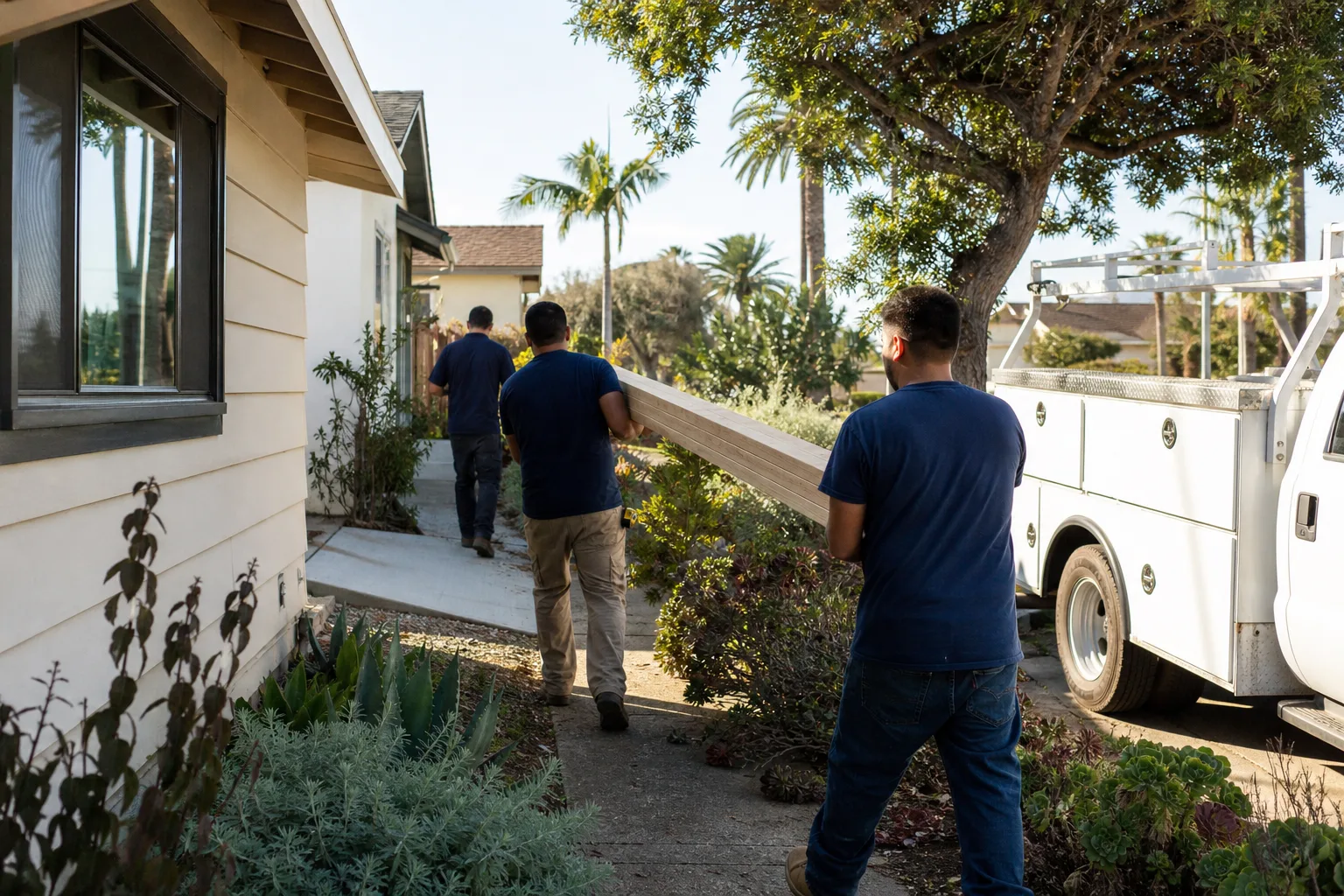
The first two weeks of a healthy Orange County ADU project look like this: a clean job site, a posted permit, a portable toilet (required by Cal/OSHA), a dumpster or debris container, and a crew that can tell you what phase they’re in and what comes next. The first two weeks of a troubled project look different, and if you know what to look for, you’ll see the trouble before it costs you money.
No posted permit. We’ve covered this, but it bears repeating because it’s the easiest warning sign to check and the most frequently ignored. Walk by your own job site on day one. Look for the permit. Not there? Stop the work and call the contractor. This is not a small detail. It’s the legal foundation of the entire project.
Subcontractors who don’t know the project scope. A framing crew that shows up at your Orange County property and asks what they’re building has not been briefed by the general contractor. That’s not a communication style. That’s a management failure. When subs don’t know the scope, they build to their own assumptions, and their assumptions become expensive change orders. Ask any sub what they’re doing that day. If they can’t answer in one sentence that matches the written scope, you’ve found a problem.
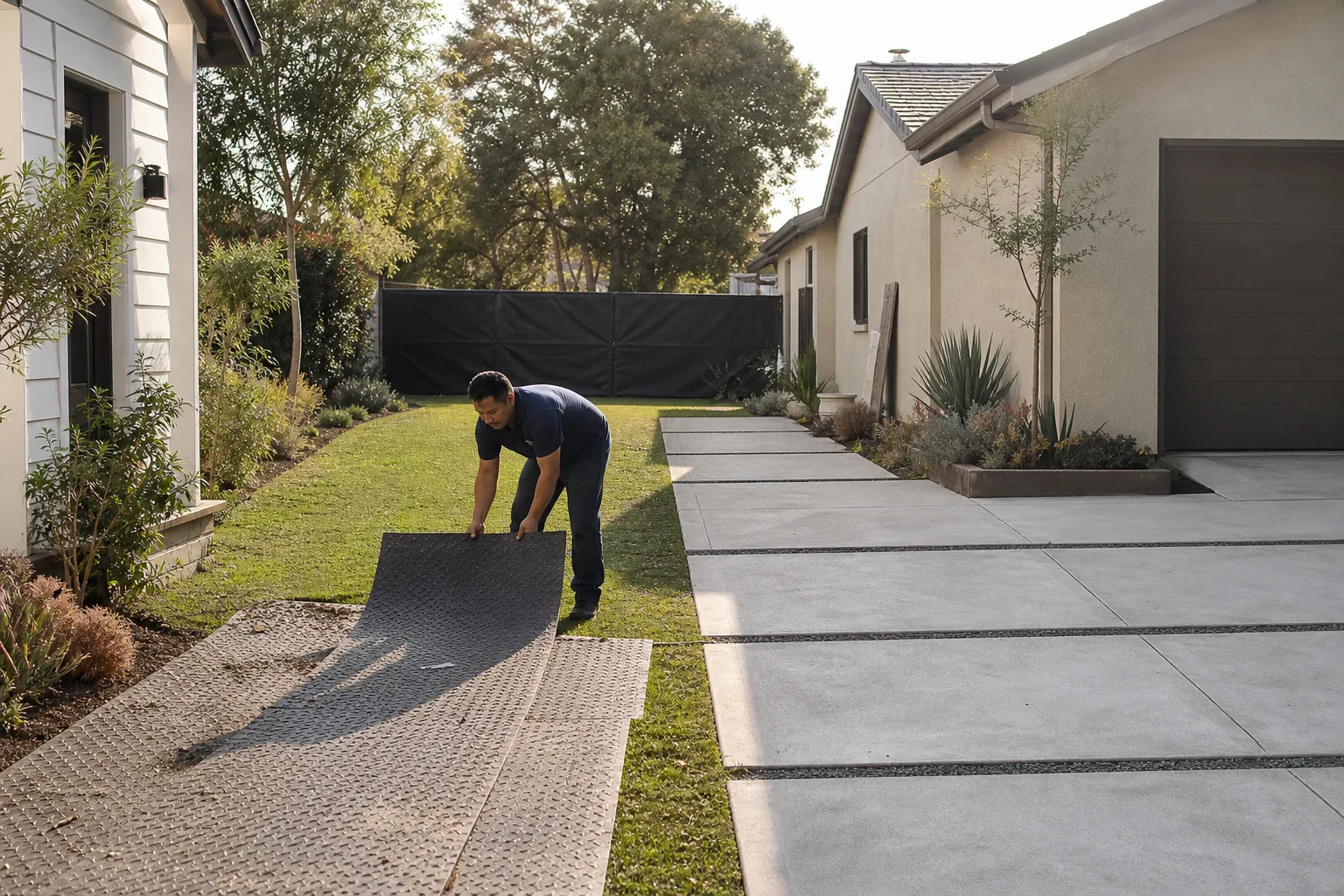
Materials left unprotected from weather. Orange County doesn’t get much rain, but it gets marine layer moisture near the coast, Santa Ana winds that kick up dust, and summer heat that warps unprotected lumber and delaminates sheet goods left in direct sun. A contractor who leaves framing lumber, plywood, or drywall stacked on bare dirt with no tarp is signaling how they’ll treat the rest of your build. Lumber that sits in mud grows mold. Drywall that sits in damp air swells and sags. These are real costs that show up later as cracked drywall, squeaking floors, and mold behind the walls.
Site left unsecured overnight. Open trenches, unsecured lumber piles, exposed rebar, open electrical rough-in. An unsecured job site is a liability trap. Neighborhood kids wander onto the site. Rain gets into open framings. Tools walk away. A legitimate Orange County contractor secures the site every night: temporary fencing, locked gates, equipment removed or locked, holes covered. If your contractor leaves the site wide open, they’re telling you they don’t worry about consequences. That attitude will show up in the framing, the electrical work, and the final inspection too.
Here’s what we tell every homeowner we work with on ADU builds in Orange County: you should feel comfortable walking your own job site every single day and asking questions. A legitimate contractor welcomes that. A troubled contractor discourages it, schedules you away from the site, or makes you feel like a nuisance for checking. That last one is the biggest red flag of all, because it means they don’t want you to see something.
Communication Red Flags: Silence Is the Most Expensive Sound
Orange County ADU projects run three to nine months from permit to final inspection, depending on scope, municipality, and whether you’re building detached, attached, or a garage conversion. That’s a long time to be out of touch. A contractor who communicates well for the first week and then goes silent for a month is not “busy.” They’re avoiding you, and they’re avoiding you because something is wrong, over budget, or behind schedule.
The 48-hour rule. It’s the simplest standard in construction, and it’s shocking how many contractors fail it: return every client call or message within 48 hours. Not necessarily with a full answer, but with acknowledgment. “Got your message, checking on the plumbing schedule, I’ll call you Tuesday.” That’s all it takes. A contractor who can’t manage 48 hours can’t manage a $250,000 ADU project. If you’re leaving messages that go unreturned for a week at a time, document it (see the next section) and start preparing for a difficult conversation.
Verbal change orders. This is where Orange County ADU budgets go to die. The homeowner wants an extra window in the kitchen. The contractor says, “Sure, we’ll sort it out at the end.” That sentence is the most expensive sentence in residential construction. A legitimate change order is a written document that describes the change, states the price, and adjusts the schedule. It’s signed by both parties before the work is done. Our operating standard at Lodgewick is built on this principle-just as we outline in our DIY vs Professional ADU guide: nothing changes without a written change order. No exceptions. If a contractor tells you not to worry about it, worry about it.
No written schedule. Every ADU project should have a written schedule, even a rough one. It doesn’t need to be perfect. It needs to exist. “Foundation by mid-March, framing by late April, rough electrical by May, drywall by June, final by late August.” The schedule will slip; all schedules slip. But when there’s a written schedule, slippage is visible and measurable. When there isn’t, there’s no way to tell if you’re three weeks behind or three months behind until the contractor stops returning your calls.
The project manager shuffle. One PM quits, another takes over, then a third. This happens in construction, and it’s not automatically a disaster. But if your project has three different project managers in three months and no one has given you a written handoff summary, the institutional knowledge of your project is walking out the door each time. You become the only person who knows the whole story, and you didn’t sign up for that job.
A Healthy Communication Pattern Looks Like This
- Weekly update, in writing. An email or text every Friday. What got done this week, what’s scheduled next week, any issues or upcoming decisions. Two minutes to write, priceless to receive.
- Inspection notices. You receive notice before each city inspection, and you receive the inspection result within 24 hours. Pass or fail, you know.
- Change orders in writing, every time. No exceptions. Every change has a price and a signature before the work happens.
- Final walkthrough scheduled in advance. Not “we’ll get to it.” A specific date and time, written, confirmed, kept.
If your current contractor can’t meet those four standards, the communication problem is not going to improve when the pressure increases. And it always increases.
How to Document Problems Like a Professional
Here’s the uncomfortable truth about construction disputes in Orange County: the party with better documentation wins. Not the party who’s right. The party who can prove it. Contractors who create trouble are usually experienced at defending against it. Homeowners who’ve never been through a dispute are not. The way to level the field is to document everything from day one, before you know you need it, because once you know you need it, you’re already behind.
Start a project file the day you sign the contract. Digital or physical, doesn’t matter. What matters is that everything goes in it. Contract, change orders, payment receipts, permit documents, inspection reports, text messages, emails, photos. Every single communication with the contractor, in writing. If a conversation happens on the phone, follow it up with an email: “Just to confirm our conversation today, you said the framing inspection is scheduled for Thursday. Please correct me if I misunderstood.” That email is your documentation. Send it every time.
Photos are your best friend, especially in a dispute. Take photos of the site every single day. Date-stamp them. Store them in a folder organized by week. When the contractor says “that crack was there before we started,” you’ll have a photo from the day before showing it wasn’t. When they say “we never installed that fixture,” you’ll have a photo of it going in. Photograph everything: the permit posted on day one, the condition of materials when they arrive, the trench before it’s backfilled, the framing before drywall goes up, the final result. Every photo is a piece of evidence, and evidence is what wins disputes.
The Written Notice Letter
When a problem arises that you’ve tried to resolve verbally and it isn’t getting fixed, send a written notice letter. It doesn’t need a lawyer’s language. It needs to be clear, specific, and dated:
- The problem, described factually. “The back deck ledger board was attached without flashing, and water is getting into the wall cavity.”
- The date you first noticed it.
- The date you first brought it to the contractor’s attention.
- The response you received.
- What you’re requesting: a written plan to fix it, with a date.
Send it by email with read receipt, or by certified mail. Keep a copy in your project file. This letter matters because it creates a written record that you notified the contractor of a defect. In a CSLB complaint or civil case, that record is the foundation of your claim.
The California Contractors State License Board Complaint Process: Real Timelines
If your Orange County ADU contractor has breached the contract, abandoned the project, done defective work, or refused to honor a written warranty, the California Contractors State License Board (CSLB) is your primary state-level recourse. The CSLB is not fast. It is not customer-friendly in the way a retail return is. But it has real teeth, and it’s the main reason California has stricter contractor accountability than most states.
Here’s what the process actually looks like, with realistic timelines based on CSLB’s published performance data and our experience watching Orange County homeowners navigate it:
- Filing the complaint (Week 1). You file a complaint with the CSLB online or by mail. You include your project file, your photos, your written notice letter, your contract, and a clear statement of the issue. The CSLB opens a case and assigns an investigator.
- Investigation and mediation attempt (Weeks 4-16). A CSLB representative reviews your complaint and contacts the contractor. Many complaints are resolved at this stage through voluntary mediation. The contractor is given a chance to fix the problem, complete the work, or refund money. A surprising number of contractors become very responsive once the CSLB calls.
- Formal investigation (Weeks 8-26). If mediation fails, the case moves to a formal investigation. The CSLB may inspect the work, interview witnesses, and review permits and records. This is where your documentation matters most.
- Enforcement action (Months 6-18). If the CSLB finds a violation, it can issue a citation, suspend or revoke the contractor’s license, and require restitution. The CSLB also maintains a public record of the violation on the contractor’s license, which follows them forever.
Two things to know. First, the CSLB cannot award you money directly except through a restitution order, and collecting restitution can be slow. If your loss is substantial, you may want a construction defect attorney in parallel. Second, the CSLB’s complaint process is most effective when the contractor is licensed. If you hired an unlicensed contractor, the CSLB can investigate but cannot enforce against a license that doesn’t exist. That’s a good argument for checking your contractor’s license number on the CSLB website before you sign anything.
One more note, because we’ve seen this play out in Costa Mesa and Fullerton and everywhere in between: homeowners who wait to file until the contractor has disappeared entirely have a much harder time than homeowners who file at the first sign of serious trouble. The CSLB has more leverage over a contractor who’s still operating and still wants to keep their license. File early. You can always withdraw the complaint if things get resolved.
The 10% Deposit Rule and Other Orange County Legal Protections
California gives ADU homeowners more legal protection than most construction clients in the country, and most of them never use it because they never knew it existed. Here’s what you’re entitled to, in plain language, on every ADU project in Orange County.
The 10% Down Payment Cap
As covered above: for any home improvement contract over $500, the contractor cannot take more than $1,000 or 10% of the total, whichever is less, as a down payment. This is California Business and Professions Code 7159. A contractor who asks for 25% or 50% upfront on a $250,000 ADU is breaking the law in a way that’s easy to verify and impossible to excuse. Walk away, and report them to the CSLB.
The Three-Day Right to Cancel
California law gives you three business days to cancel a home improvement contract without penalty, for any reason or no reason. The contractor must provide you with a written notice of this right at the time you sign. If they don’t, the cancellation window may not have started yet. Use this right if you sign something and then realize the numbers don’t add up or the scope is vague. Three days is enough time to have a lawyer or a knowledgeable friend review the contract.
Mechanics Liens
If your contractor doesn’t pay their subcontractors or suppliers, those parties can file a mechanics lien against your property, even if you paid the contractor in full. A mechanics lien can prevent you from selling or refinancing until it’s resolved. The protection against this is to require lien releases from the contractor every time you make a progress payment. A lien release is a signed document confirming that the contractor has paid their subs and suppliers for work covered by that payment. Legitimate Orange County contractors provide lien releases as standard practice. This is also where a written payment schedule tied to completed phases protects you: you’re paying for work that’s done, and you have documentation of it.
Written Warranty Requirements
California requires contractors to provide a written warranty on workmanship for at least one year after completion for most residential projects. This isn’t a nice-to-have. It’s law. If your contractor doesn’t offer a written warranty, they’re either ignorant of the law or planning to violate it. At Lodgewick, our 365-Day Done Right Promise-detailed in our Home Addition Contractor Maintenance Checklist-goes a step further: if the work isn’t done right, we come back and make it right, and that commitment is in writing on every project before work begins. That’s not a marketing slogan. It’s a contract term. And every Orange County homeowner should demand something similar from any contractor they hire.
Common Mistakes to Avoid
- Paying more than 10% upfront. It’s illegal, and it puts you at risk. No legitimate contractor needs more to start an ADU in Orange County. Contractors who manage cash flow responsibly use progress payments, not giant upfront deposits.
- Signing a contract without a written scope. A contract that says “build an ADU per plans” without itemizing what’s included is a blank check. Insist on a line-item scope that covers every phase of the project.
- Allowing work to start before the permit is issued. Demo before permit is a stop-work order waiting to happen. In some Orange County cities it also triggers fines that the homeowner ends up paying.
- Letting change orders go verbal. “We’ll sort it out at the end” means you’ll pay for it at the end and you’ll have no documentation of what you agreed to. Written change orders, every time, signed by both parties.
- Not checking the contractor’s license and workers’ comp before signing. The CSLB website takes two minutes to search. An unlicensed contractor can’t pull permits, can’t be held accountable by the CSLB, and is likely not carrying workers’ comp. The risk is yours.
- Not documenting the job site with daily photos. When a dispute happens, the party with photos wins. Take photos every day from day one. Store them where you won’t lose them.
- Filing a CSLB complaint only after the contractor disappears. File early, while the contractor still has a license to lose. Withdrawal is easy if things resolve.
When to Call a Professional
Some ADU warning signs resolve with a conversation. Some require a professional to step in, and the distinction usually comes down to money and safety. If you’ve documented a contractor violating the 10% deposit rule, pulling permits under the homeowner’s name, starting demo without a permit, or leaving the job site structurally unsafe (open trenches, exposed electrical, unsecured framing), you’re past the point of friendly reminders. Those are the situations where a construction attorney or the CSLB should be involved, and the sooner the better. If you’re still in the planning phase and want to avoid all of this entirely, Lodgewick ADU Orange County home offers free written estimates for ADU builds, garage conversions, and home additions throughout Orange County. We put real numbers on paper before any work begins, and every project includes the 365-Day Done Right Promise in writing. Call (350) 203-6060 to schedule yours.
Frequently Asked Questions

ADU construction in Orange County typically runs $250 to $450 per square foot, depending on the city, the complexity of the site, and the level of finishes. A 500-square-foot garage conversion usually lands between $125,000 and $225,000, while a 1,000-square-foot detached ADU can run $250,000 to $450,000. These ranges are broad because Orange County spans 34 cities and unincorporated areas, each with different permit fees, impact fees, and site conditions. Garage conversions in Orange County are often the most cost-effective path because the structure already exists. Call (350) 203-6060 for a written estimate on your specific lot.
The contractor who asks you to pull the permit yourself is the single most reliable warning sign. When a contractor puts the permit in your name, they’re transferring legal liability for the entire project to your shoulders. No legitimate Orange County ADU contractor does this. It’s the number one reason homeowners end up with unpermitted structures they can’t rent, sell, or insure.
Not just normal. It’s the legal maximum in California for any home improvement project over $500, including every ADU in Orange County. A contractor can accept up to $1,000 or 10% of the contract price, whichever is less. Anything beyond that is a violation of California Business and Professions Code Section 7159 and grounds for a CSLB complaint. Call (350) 203-6060 to discuss what a compliant payment schedule looks like.
A typical Orange County ADU takes three to nine months from permit approval to final inspection, depending on the type of unit (detached, attached, or conversion), the municipality, and the complexity of the site. Permitting alone can take one to three months depending on the city. A contractor who promises a full detached ADU in six weeks is not being honest about Orange County’s permitting and inspection process.
Document everything, send a written notice letter demanding a completion plan, and file a complaint with the California Contractors State License Board immediately if the contractor is licensed. You may also need a construction attorney to pursue a civil case for breach of contract. The CSLB can suspend or revoke the contractor’s license and order restitution, but the process takes months, so the sooner you start, the better. A home addition contractor in Orange County with a written guarantee and a documented track record is your best protection against abandonment.
Yes, in some important ways. While California’s statewide ADU laws set the broad framework, each Orange County city sets its own zoning rules, setback requirements, height limits, and permit fees. Some cities, like Irvine and Anaheim, have adopted ADU-friendly expedited review processes; others move more slowly. Your contractor should know the specific requirements of the city where you live, not just the state standards. That’s part of the value of working with a builder who knows Orange County’s regulatory landscape city by city, and you can find more guides & resources on our blog to help navigate it.
The Bottom Line
ADU projects fail in predictable ways, and nearly all of those failures show early warning signs. A contractor who won’t put the price in writing, who asks for more than the legal 10% deposit, who pulls the permit in your name, who starts demo before the permit clears, who leaves the site unsecured, who goes silent for weeks at a time, who delivers change orders verbally. These aren’t quirks. They’re the early symptoms of a project that’s going to cost you more than it should, take longer than it should, and leave you with a structure you can’t legally rent or sell. The good news: you don’t need to be a construction expert to spot any of them. You just need to know what you’re looking at, and now you do. If you’re planning an ADU, garage conversion, or home addition in Orange County and want a written price and a written guarantee before any work begins, call Lodgewick ADU Orange County at (350) 203-6060 for a free estimate.
Written by Russ Delmar, Owner at Lodgewick ADU Orange County, serving Orange County since 2010.